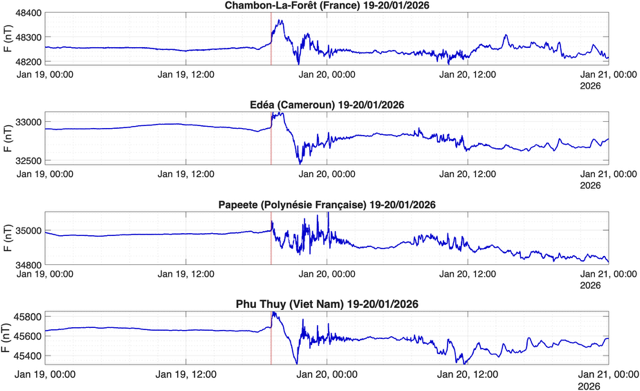
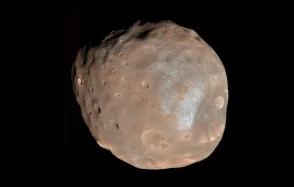
On the evening of 19/01/2026 a rapid variation of the magnetic field, synchronous on a large part of our planet, has been detected by an automatic system developed at IPGP with CNES support with available events archive.
This system analyses in quasi-real time the data of the ambient magnetic field measured by the global network of magnetic observatories managed by IPGP (https://www.bcmt.fr) on various continents, and at the Guam observatory (USGS) in the Pacific sector. An automatic information is produced when a coherent signal is found on the majority of the observatories.
Synchronous effect on all observatories
The detected event constitutes the response of the electric currents circulating at the edge of the terrestrial magnetosphere, several tens of thousands of kilometres above our heads. Usually this phenomenon produces variations of few tens on nT on the ground measurements. On the evening of 19/01, an exceptional augmentation of 70 nT in one minute has been observed in Chambon-la-Forêt (Loiret, France) and the strongest variation on the whole of the network was 178 nT, observed in Edéa (Cameroon). In the following hours, a major magnetic storm developed, with a visible effect in the auroras visible also in France.
For more information on this event, from the solar observations down to the effects on our planet, read the INSU news.
The Sun keeps being very active, with solar flares occurring nearly every day, other similar events could occur again in the coming weeks and months.