
Citizen / General public
Researcher
Student / Future student
Company
Public partner
Journalist
Teacher / Pupil

A new isotopic clue reveals the origin of the asteroid responsible for the extinction of the dinosaurs

A study led by Georgy V. Makhatadze, a postdoctoral researcher at the Institut de physique du globe de Paris (Université Paris Cité / CNRS) under the supervision of Frédéric Moynier, as part of an international collaboration, provides new constraints on the origin of the asteroid responsible for the extinction of the non-avian dinosaurs. Based on high-precision analyses of nickel isotopes, the results indicate that the impactor was most likely a CO-type carbonaceous chondrite
A new isotopic clue reveals the origin of the asteroid responsible for the extinction of the dinosaurs

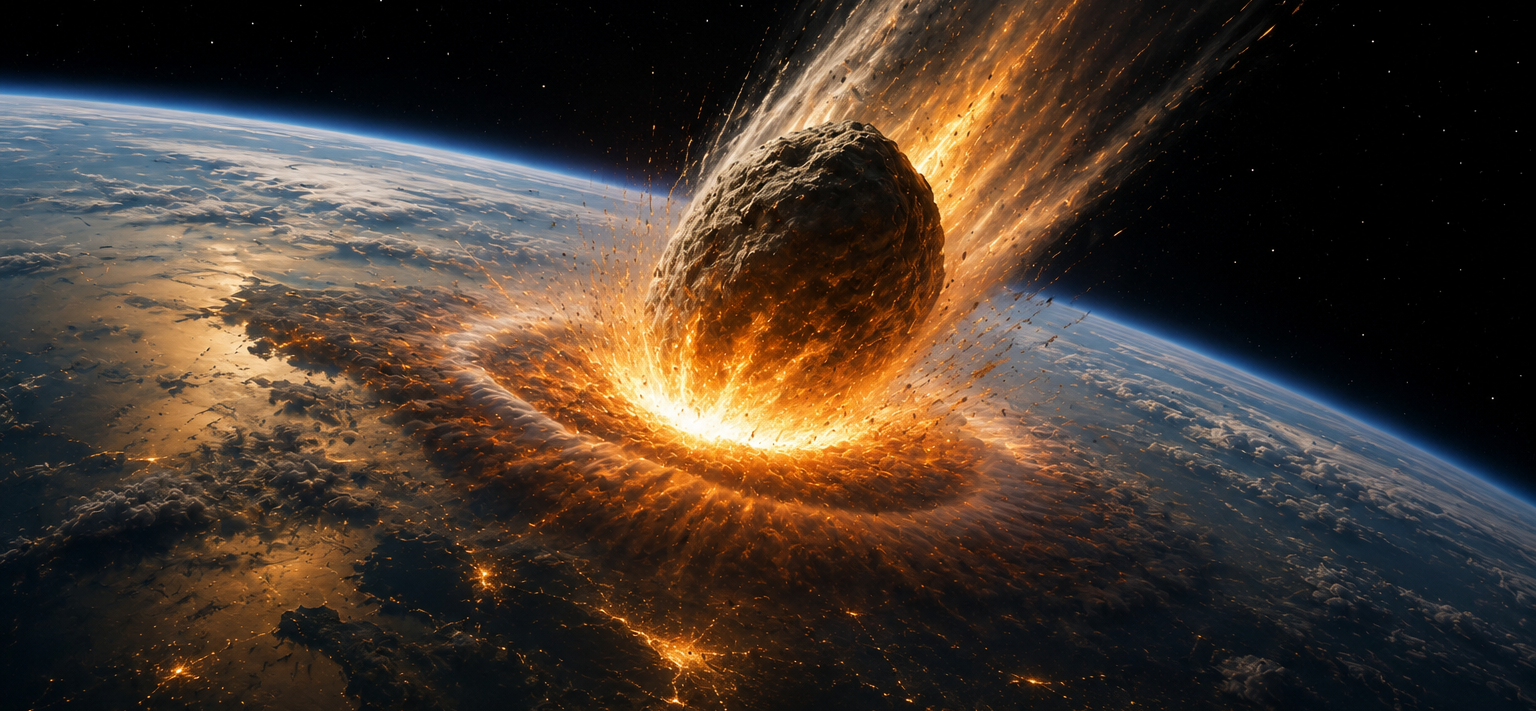
Illustration of the impact on Earth of the asteroid that wiped out the dinosaurs / @IPGP

Publication date: 17/07/2026

Research

Sixty-six million years ago, the collision of an asteroid with Earth triggered one of the greatest biological crises in the planet’s history. This event, which formed the Chicxulub crater in present-day Mexico, led to the extinction of approximately 75% of all species, including the non-avian dinosaurs. While the extraterrestrial origin of the impact is now firmly established, the precise nature of the asteroid has remained a matter of debate.

Nickel isotopes reveal the impactor’s fingerprint

To identify the origin of the celestial body, the researchers analyzed marine clay deposits from the Cretaceous–Paleogene (K–Pg) boundary collected in Denmark, Spain, and Italy. These sediments contain a minute fraction of extraterrestrial material derived from the impact. For the first time, the team measured the nickel isotopic composition of these samples with extremely high precision, alongside a large collection of meteorites representative of the different reservoirs of the early Solar System. Nickel isotopes provide a distinctive fingerprint of meteorite parent bodies, making it possible to distinguish among different families of carbonaceous chondrites. “Nickel isotopes provide a particularly powerful tool for identifying the nature of extraterrestrial materials,” explains Georgy Makhatadze. “In the case of the K–Pg boundary, they allow us to place strong constraints on the nature of the impactor.”

A CO-type impactor, drier than previously proposed scenarios

The results show that the isotopic signatures of the K–Pg samples are consistent with a mixture of terrestrial material and CO-type carbonaceous chondrites. This conclusion rules out several other meteorite types that had previously been proposed, including some carbonaceous chondrites that are significantly richer in volatile compounds. This finding is important because CO chondrites are relatively depleted in volatile elements such as water and sulfur, unlike CM chondrites, which have often been invoked in models of the Chicxulub impact. “This suggests that the impactor may have delivered fewer volatile compounds than previously thought,” says Frédéric Moynier. “A significant proportion of the climatic disturbances may therefore have resulted from terrestrial materials vaporized during the impact.”

Reconstructing the origin of major impacts

Beyond the specific case of Chicxulub, this study demonstrates the effectiveness of nickel isotopes as tracers of extraterrestrial material preserved in Earth’s geological record. These findings open new perspectives for improving our understanding of major impact events in Earth’s history and their environmental and biological consequences. The study was conducted in collaboration with Vrije Universiteit Brussel and the University of Vienna.

Reference

Makhatadze G. V., Moynier F., Brun L.-A., Goderis S., Claeys P., Koeberl C.
The origin of the Cretaceous–Palaeogene impactor revealed by nickel isotopes

Latest news
A remnant from Earth's early history identified in an active volcano near Mayotte
A study led by scientists from the Institut de physique du globe de Paris, in collaboration with the École Polytechnique Fédérale de Lausanne, reveals...
SOUFRIÈRE_50 – 50 years of scientific advances on volcanoes for a more resilient future
Few days before the opening of the international conference SOUFRIÈRE_50 – 50 years of scientific advances on volcanoes for a more resilient future, t...
Wildfires: nanoparticles reveal combustion conditions
A study conducted by researchers at the Institut de physique du globe de Paris (IPGP) and Université Paris Cité, in collaboration with Memorial Univer...
Radio ‘whistlers’ originating from lightning strikes reveal unprecedented behaviour above the magnetic equator
A team from the Institut de Physique du Globe de Paris (IPGP – Université Paris Cité / CNRS) has, for the first time, documented and explained the unu...