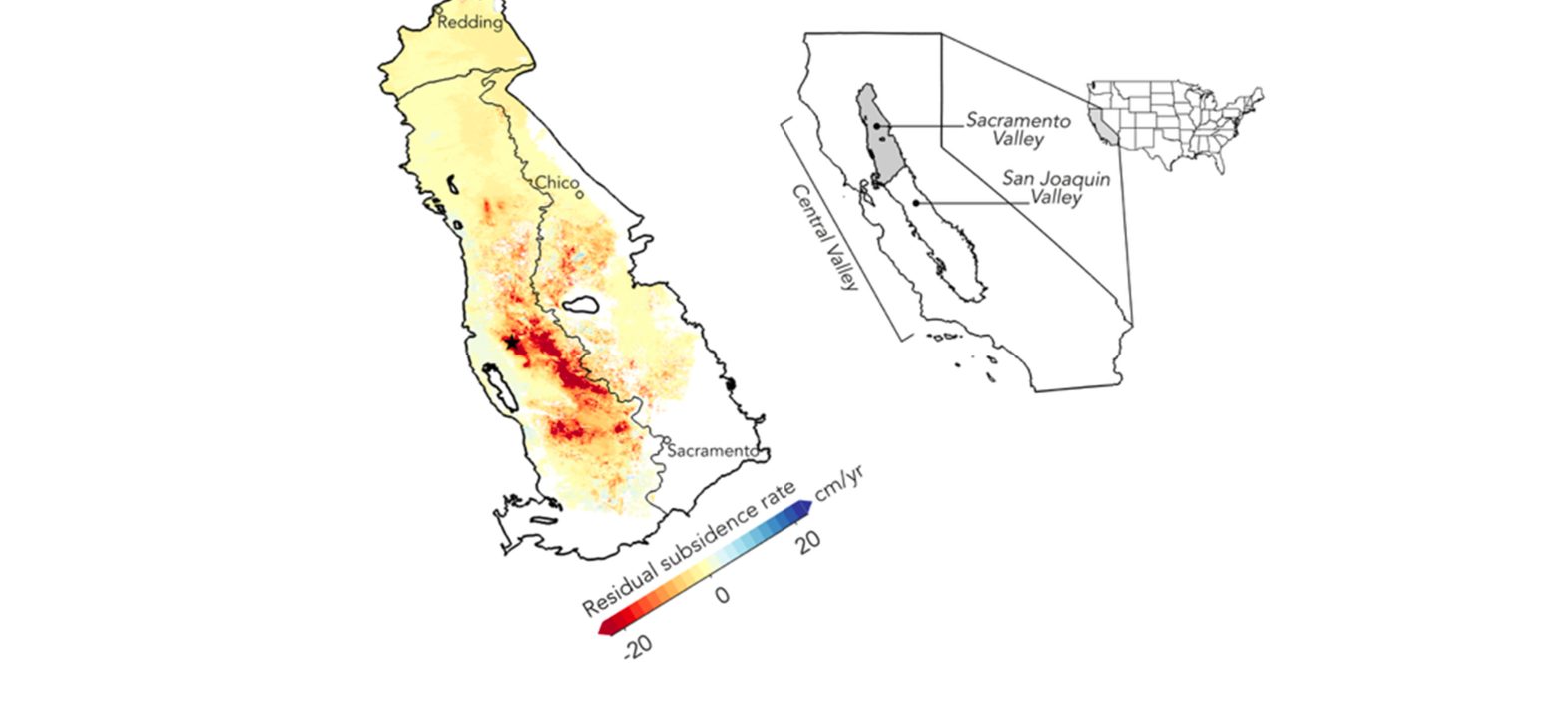
Aquifers are among the planet’s most important freshwater reservoirs. They play a vital role in supplying drinking water, sustaining agriculture and supporting numerous ecosystems. However, excessive groundwater extraction can cause irreversible damage to aquifer systems that is difficult to anticipate.
This is precisely what an international study published in Proceedings of the National Academy of Sciences(PNAS) reveals. Led by Stacy Larochelle, a former Caltech student who spent time at the IPGP through a Chateaubriand Fellowship, the research also involved Kristel Chanard, Manon Dalaison and Jean-Philippe Avouac, researchers at the IPGP.
An abrupt shift during the 2020–2022 drought
In an aquifer, the pressure exerted by groundwater helps support the overlying geological layers. When groundwater is extracted, the aquifer materials compact, causing the land surface to subside.
This deformation can be elastic, when the ground rebounds as the aquifer is naturally recharged, or inelastic, when compaction becomes permanent and irreversibly reduces the aquifer’s water storage capacity.
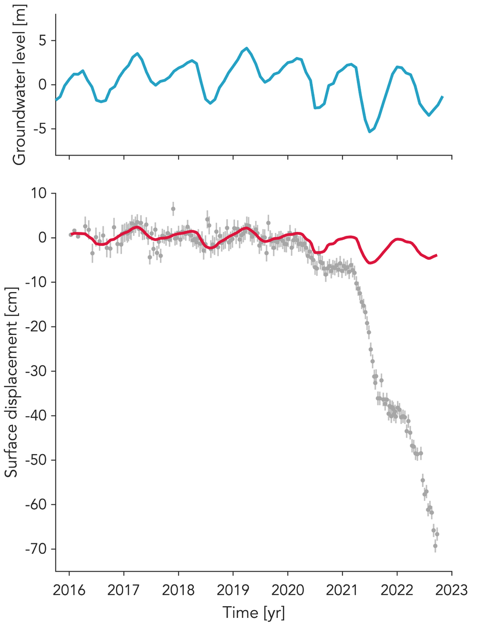
By combining high-resolution satellite measurements with groundwater level records from monitoring wells between 2016 and 2022, the researchers identified a major shift during the 2020–2022 drought.
Until 2020, the observed subsidence remained consistent with predominantly reversible, elastic deformation. However, beginning in 2021, subsidence rates increased dramatically, exceeding by several tens of centimetres per year the values expected from a purely elastic response of the aquifer.
Satellite geodesy as a new early warning tool
One of the study’s most significant findings is that this transition to irreversible deformation could not have been predicted from groundwater level measurements alone.
Satellite geodetic observations, however, capture changes in the mechanical behaviour of the subsurface, making it possible to detect the onset of permanent damage.
These results highlight the value of space geodesy techniques for monitoring aquifer health and providing useful tools for groundwater resource management.
A global challenge in a changing climate
As extreme droughts are expected to become more frequent under climate change, preserving groundwater resources is becoming an increasingly urgent global challenge.
This study demonstrates that satellite geodetic observations could make it possible to monitor the evolution of aquifers in near real time and identify the earliest signs of irreversible loss of storage capacity, paving the way for more sustainable groundwater management.
Reference
Larochelle, S. et al. Abrupt transition to irreversible damage in the overdrafted Sacramento Valley aquifer system. Proceedings of the National Academy of Sciences (PNAS). Publication scheduled for 27 July 2026.