
Citizen / General public
Researcher
Student / Future student
Company
Public partner
Journalist
Teacher / Pupil

Atmospheric nanoparticles: a methodological breakthrough for the analysis of urban bioindicators

A team from the Institut de Physique du Globe de Paris (IPGP – Université Paris Cité), in collaboration with the Muséum national d'Histoire naturelle and CEREGE, has published a study in the Journal of Hazardous Materials proposing an innovative methodological framework for characterising atmospheric nanoparticles accumulated in tree bark, used as a passive bioindicator of urban pollution. Tree bark, an archive of nanoparticle exposure Metal and metal oxide nanoparticles emitted in urban environments are emerging contaminants whose detection and quantification remain analytically complex.
Atmospheric nanoparticles: a methodological breakthrough for the analysis of urban bioindicators

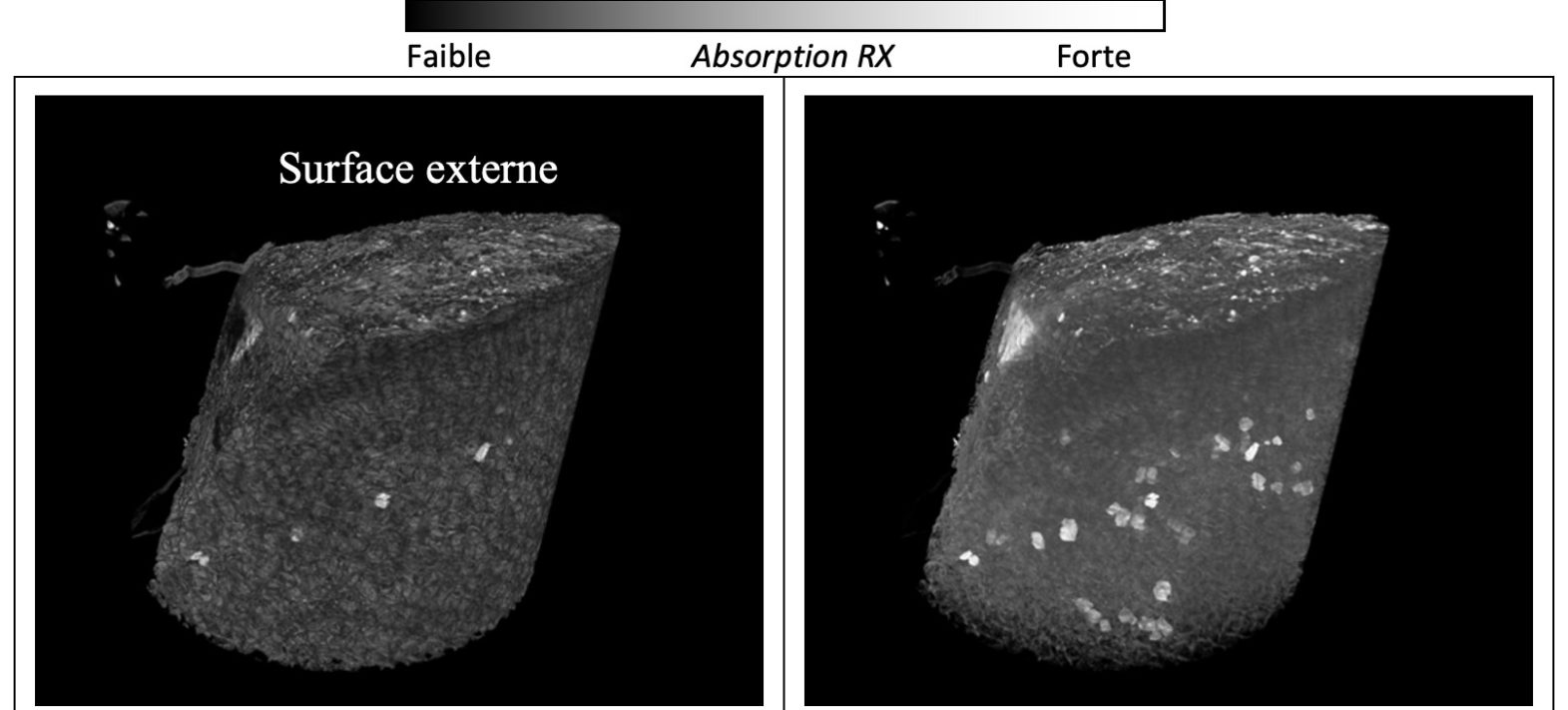
The 3D reconstruction of the bark obtained using micro-CT (1 slice = 1 μm) revealed a scattered distribution of inorganic particles throughout the bark (from the surface to the core) – and the consequent need for complete selective degradation of the bark

Publication date: 16/03/2026

Research
Tree bark acts as a passive filter, recording chronic exposure to ultrafine particles.

Using multi-scale analyses (scanning electron microscopy, X-ray microtomography, elemental mapping), researchers have shown that inorganic nanoparticles – mainly iron and copper oxides – are distributed unevenly: they accumulate mainly on the outer surface of the bark, while partially penetrating the internal porous structures. The morphology of the bark thus plays a decisive role in the selective retention of atmospheric particles.

Degrading the organic matrix without altering the nanoparticles

One of the major obstacles is the ability to effectively remove the lignocellulosic organic matrix while preserving the integrity of the incorporated nanoparticles.
The study compares two degradation protocols:
•    cold oxygen (O₂) plasma treatment,
•    chemical digestion with tetramethylammonium hydroxide (TMAH).

O₂ plasma can remove up to 89% of the dry mass of bark, with almost complete degradation of lignin and cellulose confirmed by spectroscopic analysis. However, the impact on the stability of nanoparticles depends on their chemical nature: while titanium (TiO₂) and aluminium (Al₂O₃) oxides are preserved, iron, copper and manganese oxides may undergo partial transformation or dissolution. Digestion with TMAH induces dissolution or aggregation phenomena linked to chemical interactions in a basic environment.

Towards analytical protocols adapted to complex matrices


These results highlight the importance of choosing the right sample preparation protocols when interpreting environmental data. To the authors’ knowledge, this study is the first systematic evaluation of these two approaches applied to tree bark for the selective extraction of inorganic nanoparticles

By providing a detailed comparative assessment of the effects of degradation on the stability and recovery of nanoparticles at environmentally relevant concentrations, this work establishes a robust methodological framework for studying the fate, persistence and potential risks associated with metallic nanoparticles in complex biological matrices.

These advances contribute to improving environmental monitoring strategies for emerging particulate contaminants and strengthening the reliability of risk assessments in urban environments.

Contact

Latest news
Guillaume Avice: CNRS bronze medal for his work on noble gases in the atmospheres of terrestrial planets
Guillaume Avice, a geochemist and cosmochemist, is a research fellow at the IPGP (CNRS/IPGP/University of Paris Cité). He uses mass spectrometry to st...
MAJIS on board JUICE: a key instrument for exploring Jupiter’s icy moons
As part of the team involved in the development and validation of the MAJIS instrument, the Paris Institute of Earth Physics is contributing to the sc...
Frédéric Moynier elected member of the Academia Europaea
Frédéric Moynier, professor at the Institut de physique du globe de Paris (IPGP) and Université Paris Cité, and Deputy Director for Research at IPGP, ...
Can we listen to Titan’s heartbeat?  Icequakes as a window into a hidden ocean.
Can we listen to Titan’s heartbeat? Icequakes as a window into a hidden ocean.
What lies beneath the surface of Titan, Saturn’s largest moon? This question is central to the upcoming Dragonfly mission, which will deploy a drone e...