Afin d'être accessible au plus grand nombre, nous vous informons que vous avez la possibilité de modifier la taille d’affichage du contenu de notre site.
Pour cela, voici les commandes à reproduire à l'aide de votre clavier :
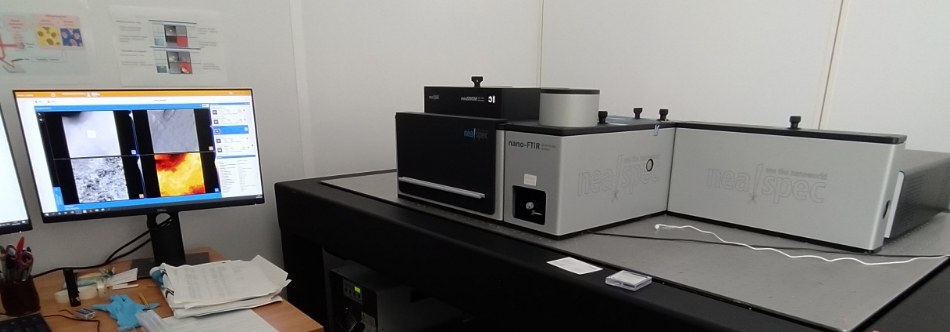
Thanks to the SESAME (Région Ile de France)/Université Paris Cité-IPGP co-funding obtained in 2019, the PARI platform was equipped in 2021 with a combined system of scattering-type scanning near-field optical microscopy (s-SNOM) and Fourier transform infrared nanospectroscopy (nano-FTIR) from Attocube, which combines imaging(topography, rigidity, optical reflection intensity) and ponctual analysis (FTIR) of surfaces at very high spatial resolution, to non-destructively highlight compositional heterogeneities on a very small scale. Compared with other systems from this supplier available in Europe, the instrument’s unique feature is its extended range of vertical movements, enabling analysis of rough samples with higher-than-usual roughness, without the need for extensive surface preparation. Near-field optical technology enables both inorganic and organic compounds to be imaged. Analysis is also possible using a combination of broadband lasers. By way of illustration, this instrument is a major asset for studying the close relationships between minerals and organic matter, whether in the context of the origin of life, the exploration of intraterrestrial microbial life or biomineralization, or any question concerning the deep carbon cycle – themes in which IPGP plays a major role on the international scene. It can, however, have a much wider range of applications across multiple thematics in Earth Sciences and other fields, and approaches can be adapted as required to complement more traditional approaches such as Raman or infrared spectroscopy. and organic compounds to be imaged. It can, however, have a much wider range of applications across multiple thematics in Earth Sciences and other fields, and approaches can be adapted as required to complement more traditional approaches such as Raman or infrared spectroscopy.
Practically:
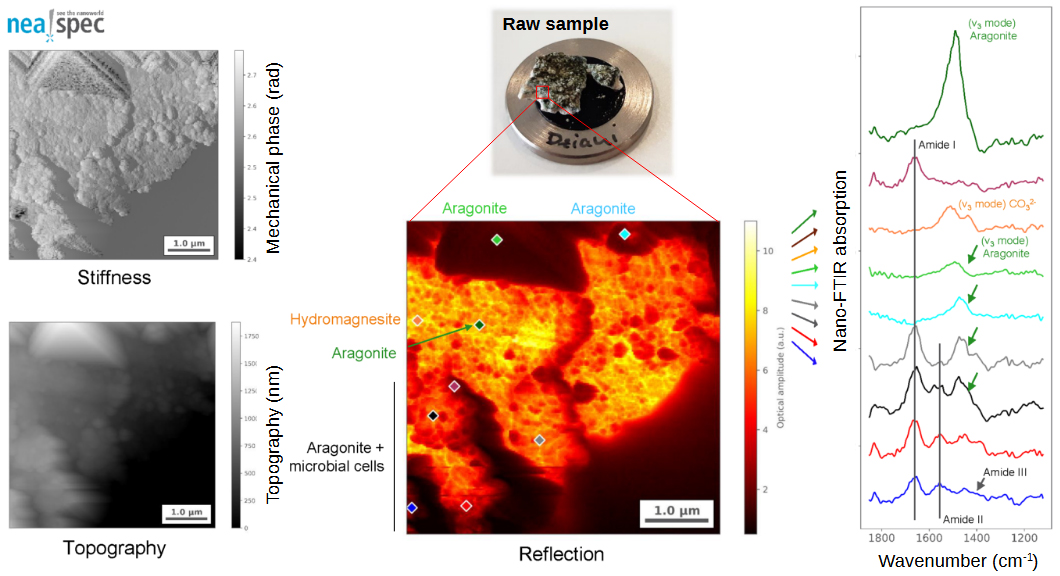
By obtaining images (topography, rigidity and optical reflection intensity) of the surface under analysis, points can be selected for spectral analysis (Figure). The spectromicroscope is controlled by NeaSCAN software (Attocube). Data processing is carried out with NeaPLOT software (Attocube). Time is needed to learn how to use these softwares.
● The sample must be solid, as flat as possible and no thicker than 10 mm ● Maximum possible roughness is 8 μm ● Broadband lasers from 2.4 to 4.2 μm and from 4.5 to 15 μm ● Spectral detection range from 2400 to 4000 cm-1 and from 650 to 2100 cm-1 ● Spectral resolution of 8 cm-1 ● Spatial resolution of 20 nm
Caption: Combined system of scattering-type scanning near-field optical microscopy (s-SNOM) and Fourier transform infrared nanospectroscopy (nano-FTIR) from Attocube.
Caption: The acquisition of nano-FTIR spectra guided by s-SNOM multimodal images (mechanical phase, topography, infrared reflection) of a few μm² enables local identification of sample components at a resolution of 20 nm (here on an unpolished stromatolite sample placed on a suitable support).
Planetary Research: a new open-access journal for planetary sciences
Led by an international community of researchers, with strong involvement from IPGP scientists, the new journal Planetary Research offers an alternati...
What if the next stars of recycling were… bacteria?
A new comic book from IPGP takes us behind the scenes of metal bio-recovery. Featuring bacteria, precious metals and a generous dose of humour, it rev...
Mapping regolith migration on Phobos to support the MMX sample-return mission
Researchers from the Institut de Physique du Globe de Paris (IPGP), in collaboration with the Centro de Astrobiología (Spain) have published a new stu...
Lorraine Delaroque and Ines Ouar, two IPGP PhD students, receive awards at international conferences
Two doctoral students from the Planetology and Space Sciences team were recently recognized for their research at two international conferences.