Afin d'être accessible au plus grand nombre, nous vous informons que vous avez la possibilité de modifier la taille d’affichage du contenu de notre site.
Pour cela, voici les commandes à reproduire à l'aide de votre clavier :
Zoom in
CTRL +
+
Zoom out
CTRL +
-
Reset to zero
CTRL +
0
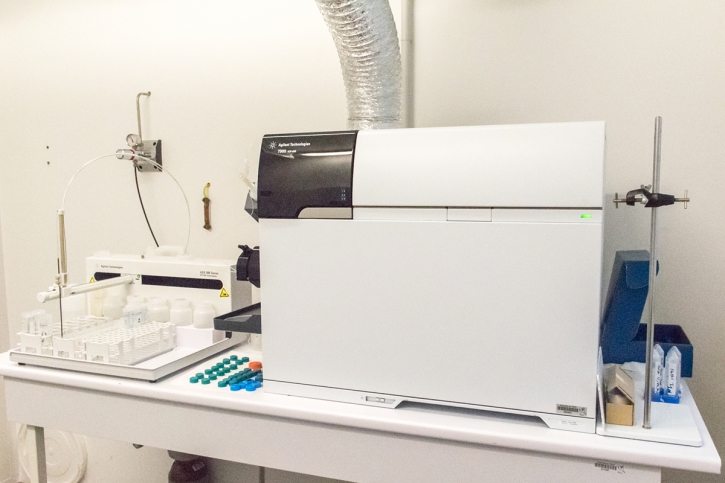
ICP-QMS 7900 Agilent
Publication date: 04/03/2026
Research
The ICP-QMS 7900 delivers best-in-class performance for multi-element trace analysis in complex matrices.
The quadrupole ICP-QMS of the PARI platform is dedicated to elemental and isotopic analysis at trace and ultra-trace levels. It enables the quantification of a broad range of elements over concentration levels spanning from a few hundred ppq to several tens of ppm, depending on the element and matrix. The instrument is well suited for applications in geosciences, environmental sciences and materials research, where high sensitivity, instrumental stability and reproducibility are required.
Samples prepared in liquid form are introduced into a high-temperature plasma, where elements are ionised and subsequently separated according to their mass-to-charge ratio (m/z). The technique provides rapid multi-element analysis with low sample consumption while maintaining very low detection limits, compatible with detailed geochemical tracing and isotopic studies.
Main analytical capabilities
Determination of major, trace and rare earth elements
Typical working ranges: – Major elements: ~0.01 to 20 ppm – Trace elements: ~0.1 to 200 ppb (down to a few hundred ppq depending on the element)
Correction of matrix effects and signal drift using internal standards
Reduction of spectral interferences through the octopole collision/reaction cell (ORS) – helium high resolution (HEHe) mode, particularly for Se
Accepted sample types
Waters, environmental solutions and biological samples analysed after appropriate preparation in liquid form (filtration, dilution, acidification…)
Solid samples (rocks, minerals, volcanic glasses, ash) analysed after chemical dissolution
Why use the PARI platform ICP-QMS?
The PARI platform ICP-QMS is the instrument of choice for studies requiring extreme sensitivity: geochemical tracing, isotopic signatures, and environmental contaminants at ultra-trace levels. It is particularly suited to projects where analytical resolution is critical to data interpretation, and where less sensitive techniques such as ICP-OES, AAS or XRF reach their limits. The PARI ICP-QMS constitutes a key analytical tool for generating robust quantitative data on trace and ultra-trace elements in the context of geoscience and environmental research.
The Agilent 7900 ICP-QMS of the PARI platform is part, at the national scale, of the CNRS-INSU research infrastructure RéGEF (in the network Géochimie élémentaire).
Planetary Research: a new open-access journal for planetary sciences
Led by an international community of researchers, with strong involvement from IPGP scientists, the new journal Planetary Research offers an alternati...
What if the next stars of recycling were… bacteria?
A new comic book from IPGP takes us behind the scenes of metal bio-recovery. Featuring bacteria, precious metals and a generous dose of humour, it rev...
Mapping regolith migration on Phobos to support the MMX sample-return mission
Researchers from the Institut de Physique du Globe de Paris (IPGP), in collaboration with the Centro de Astrobiología (Spain) have published a new stu...
Lorraine Delaroque and Ines Ouar, two IPGP PhD students, receive awards at international conferences
Two doctoral students from the Planetology and Space Sciences team were recently recognized for their research at two international conferences.