
Citizen / General public
Researcher
Student / Future student
Company
Public partner
Journalist
Teacher / Pupil

Mapping regolith migration on Phobos to support the MMX sample-return mission

Researchers from the Institut de Physique du Globe de Paris (IPGP), in collaboration with the Centro de Astrobiología (Spain) have published a new study in Earth and Planetary Science Letters (EPSL) that provides a new perspective on the surface evolution of Phobos, the largest moon of Mars. For the first time, the team has mapped the global regolith migration pathways on a small body of the Solar System using an innovative approach combining fluid mechanics and granular-flow dynamics.
Mapping regolith migration on Phobos to support the MMX sample-return mission

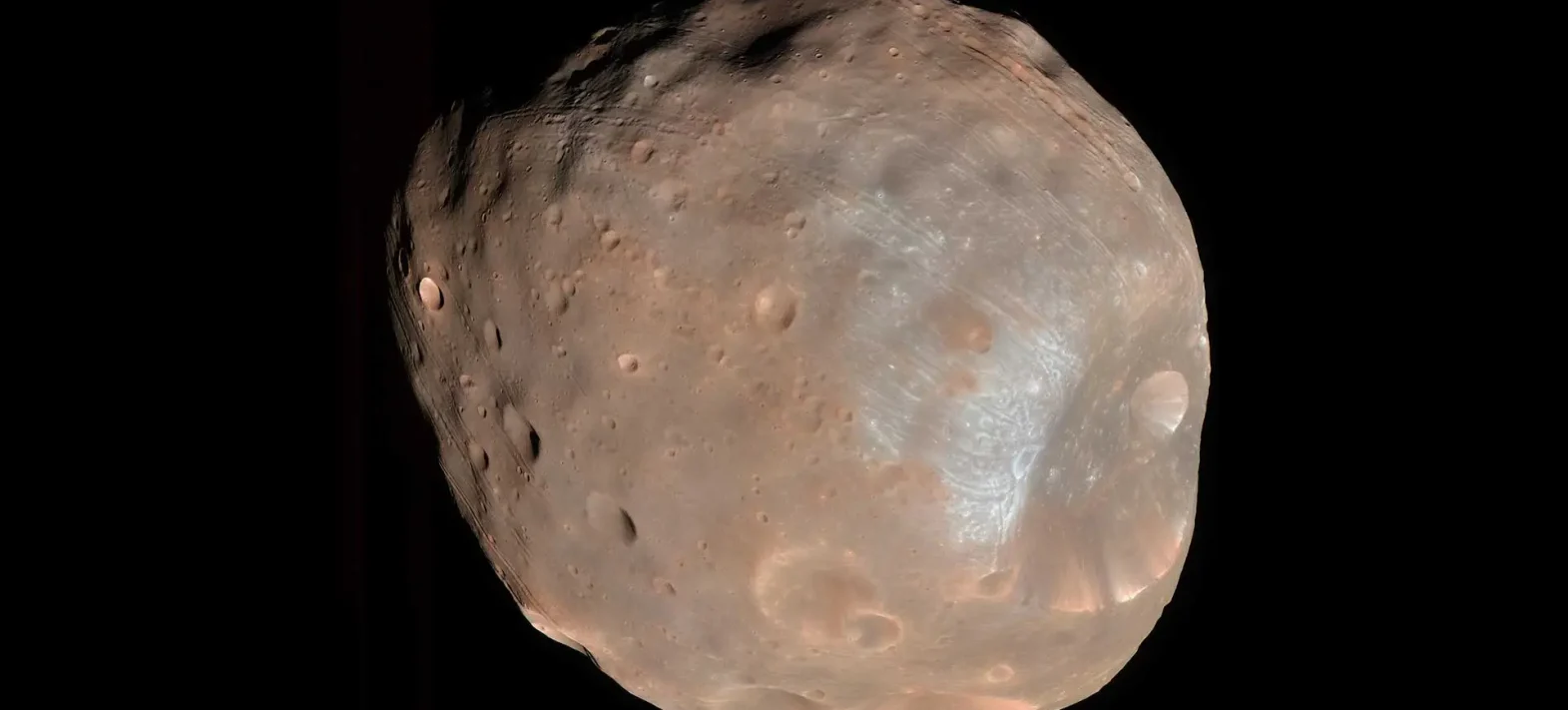
Phobos - @NASA/JPL-Caltech/University of Arizona

Publication date: 18/09/2026

Research

Starting from a three-dimensional model that accounts for the gravity, rotation of Phobos and tidal forces exerted by Mars, the study predicts the preferential routes followed by surface material. These migration pathways explain several major surface features observed by spacecraft, including the distribution of smooth and rough terrains as well as the main spectral units identified on Phobos. The work establishes a new framework for investigating the geological evolution of asteroids and planetary moons through the long-term transport of surface material.


The results are particularly important for the Japanese Martian Moons eXploration (MMX) mission, which will return the first samples ever collected from the surface of Phobos. By identifying regions where regolith is likely to accumulate and areas where fresh material is continuously exposed, the study provides valuable information for selecting future landing and sampling sites. It also offers new constraints on the mechanical properties of the surface, an important aspect for the landing and operations of the Franco-German IDEFIX rover, which will explore Phobos before sample collection.


IPGP is deeply involved in the MMX mission. Sébastien Charnoz, Frédéric Moynier and Marc Chaussidon are members of the science team of the MIRS instrument. Sébastien Charnoz is also Co-Investigator of the NavCam navigation camera onboard the Franco-German IDEFIX rover, which will be deployed on the surface of Phobos. This publication highlights how theoretical modeling, spacecraft observations and mission preparation complement one another to advance the exploration of small bodies in the Solar System.

Référence

Isabel Herreros and Sébastien Charnoz : « The dynamic surface of Phobos : a morphodynamic atlas », EPSL 2026, in press

https://www.sciencedirect.com/science/article/pii/S0012821X26004115

Above: two animations of Phobos viewed from the equator (top) and from the pole (bottom).

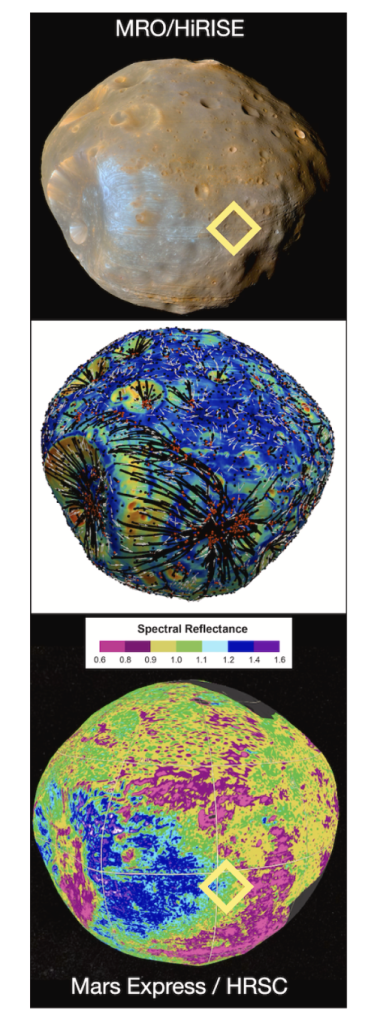
Above, surface image of Phobos acquired by the Mars Express mission; middle: preferential regolith migration pathways predicted by our model; bottom: spectral map of the surface. The main regolith transport pathways closely coincide with the blue spectral units, which are interpreted as recently exposed terrains. In contrast, the red spectral units are thought to represent older surfaces that have undergone prolonged space weathering and exposure to the solar wind. The diamond stands for the su mars point.

Latest news
Lorraine Delaroque and Ines Ouar, two IPGP PhD students, receive awards at international conferences
Two doctoral students from the Planetology and Space Sciences team were recently recognized for their research at two international conferences.
Titanium and cerium nanoparticles: in the Seine river, manufactured pollution now matches natural background
A study led by researchers at the Institut de Physique du Globe de Paris (IPGP) and Université Paris Cité shows that concentrations of manufactured ti...
Razvan Caracas elected President-elect of the International Mineralogical Association
At the IMA General Meeting held last month in Nanjing, Razvan Caracas, CNRS senior researcher at the Institut de Physique du Globe de Paris, was ele...
Nepal–Tibet: reconstructing the dynamics of a high-mountain hazard cascade
On 26 August 2026, a major rock-and-ice collapse occurred near the border between Nepal and Tibet. As it travelled through a confined valley, the movi...