Afin d'être accessible au plus grand nombre, nous vous informons que vous avez la possibilité de modifier la taille d’affichage du contenu de notre site.
Pour cela, voici les commandes à reproduire à l'aide de votre clavier :
Zoom in
CTRL +
+
Zoom out
CTRL +
-
Reset to zero
CTRL +
0
Radio ‘whistlers’ originating from lightning strikes reveal unprecedented behaviour above the magnetic equator
A team from the Institut de Physique du Globe de Paris (IPGP – Université Paris Cité / CNRS) has, for the first time, documented and explained the unusual behaviour of lightning produced electromagnetic waves detected close to the magnetic equator in the ionosphere. By analysing data from the CEA-Léti ASM magnetometers — provided by CNES to the European Space Agency’s (ESA) Swarm mission and under the scientific responsibility of the IPGP — and using a new modelling technique developed by the team, the researchers show that at very low frequencies, these signals — known as ‘whistlers’ — deviate from the classical law that described them for nearly a century. This work is published in the Geophysical Research Letters.
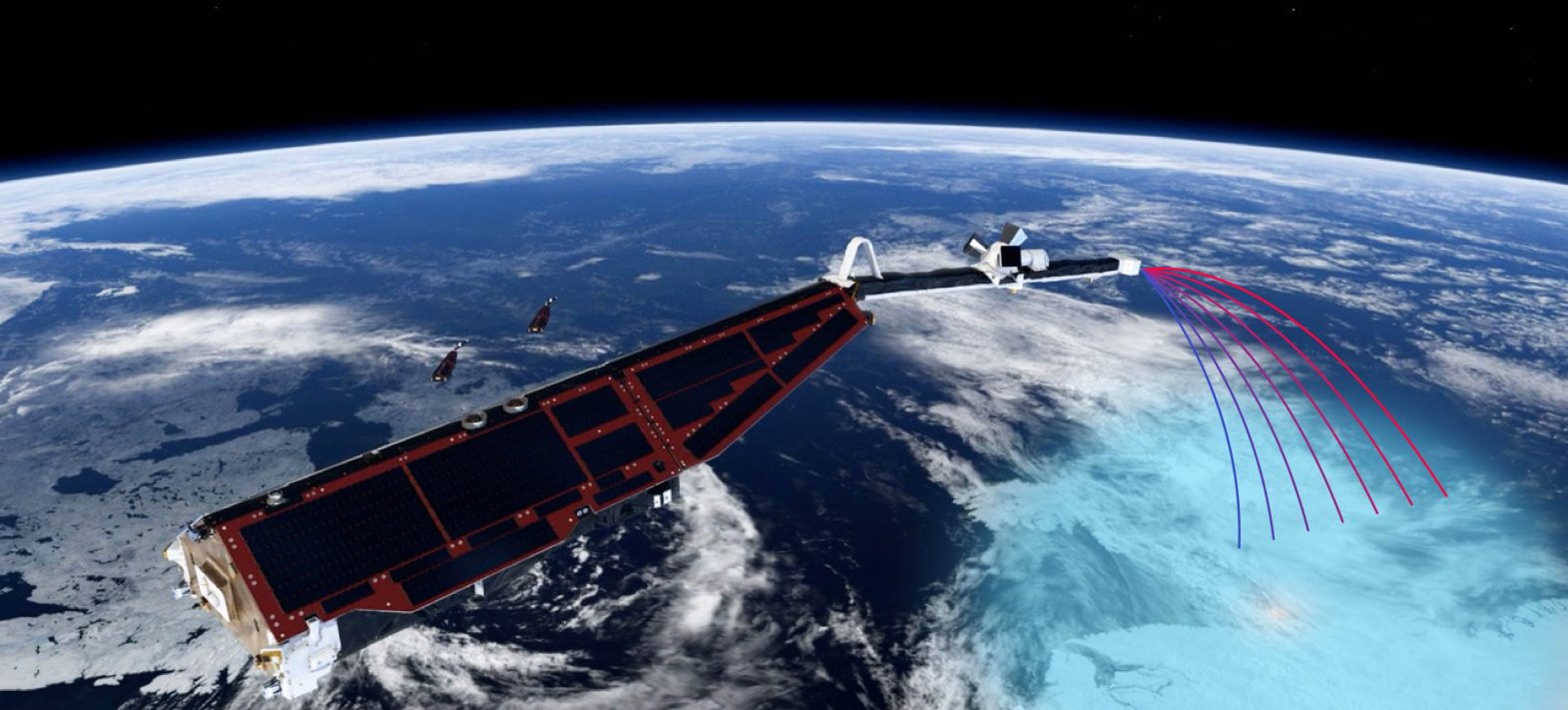
Detection by the Swarm mission of a new type of equatorial « whistlers » produced by atmospheric lightning
Publication date: 25/06/2026
Research
When lightning causes the ionosphere to ‘whistle’
Every lightning strike releases a very brief electromagnetic pulse with a very broad frequency spectrum. Part of the energy remains trapped below the ionosphere (the ionised layer of the atmosphere, above 100 kilometres altitude), while some of it escapes and propagates through the ionosphere to space, sometimes heading back to the ground.
Along the way, the ionised medium of the ionosphere sorts the frequencies: higher frequencies travel faster. The resulting signal, spread out over time according to the frequency, is called a ‘whistler’. Indeed, when converted into sound, it resembles a descending whistle. Since the pioneering work of T. L. Eckersley in 1935, who observed them as they reached back ground, this phenomenon is classically described by a simple empirical law: for each frequency, the propagation time – from the moment the source lightning strikes – is inversely proportional to the square root of that frequency.
A space mission with exceptional magnetometers
It is this law that the researchers tested on whistlers detected in the ionosphere within a frequency range little explored so far, thanks to ESA’s Swarm mission. Launched in November 2013 to study the Earth’s magnetic field, its satellites carry absolute scalar magnetometers (ASM), developed by CEA-Léti and supplied to ESA by CNES.
Since 2019, these magnetometers are regularly operated by the IPGP in a novel experimental mode that collects scalar data sampled at 250 Hz, in addition to the mission’s nominal measurements. It is precisely these data (now distributed by ESA) that enable the magnetic component of the whistlers to be detected in the extremely low-frequency range of 10 to 120 Hz.
A behaviour that defies a century-old empirical law: Eckersley’s law
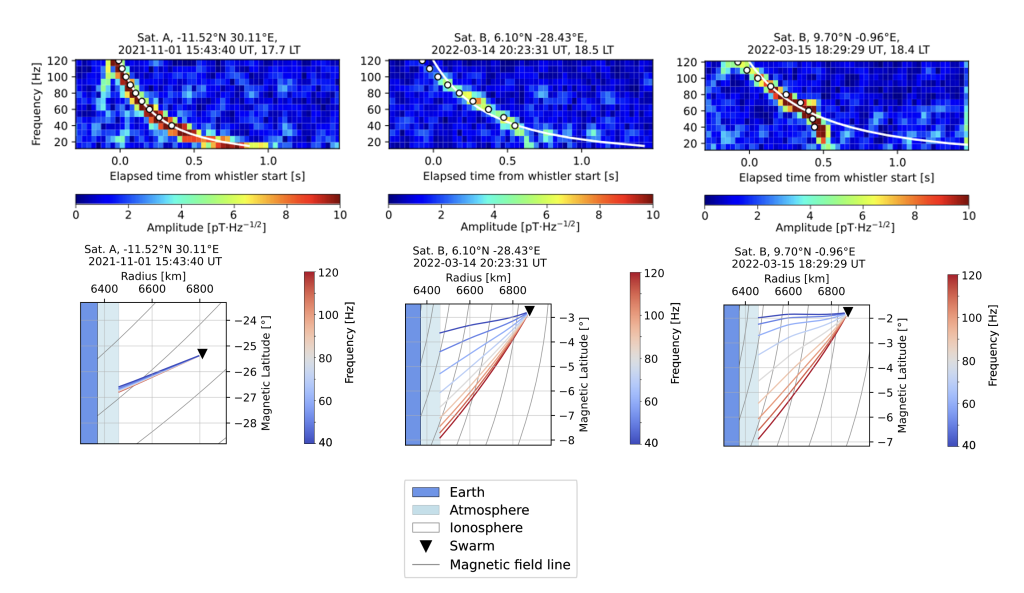
By analysing these signals, the team found that the vast majority of whistlers detected by Swarm do indeed follow Eckersley’s law. However, one category breaks the rule: those detected in the immediate vicinity of the magnetic equator. For such signals the propagation time is no longer inversely proportional to the square root of the frequency. Lowest frequencies arrive earlier than predicted by the law.
To understand this behaviour, the researchers used a two-dimensional ray-tracing technique developed as part of the PhD thesis of Martin Jenner (a thesis co-funded by CNES), who is now an engineer at ONERA in Toulouse. This model accurately reproduces the observed behaviour and, more importantly, reveals its cause.
The key: ‘fan-shaped’ paths
Far from the equator, all frequencies of a whistler follow almost identical paths through the ionosphere: only the propagation speed, function of the frequency, is responsible for the signal’s spread. This is the classical scenario described by Eckersley.
Near the magnetic equator, where the Earth’s magnetic field is almost horizontal, the situation changes radically. The paths taken by each frequency to the detection point then fan out, with their points of entry into the ionosphere potentially spanning several hundred kilometres. The lower frequencies then follow significantly shorter paths than the higher frequencies. This effect partially compensates for the fact that higher frequencies travel faster: the lowest frequencies thus arrive earlier than predicted by Eckersley’s law, which explains the unusual shape of these signals.
The researchers relate this behaviour to the fact that, close to the magnetic equator, the orientation of the magnetic field forces the waves to propagate in a so-called ‘quasi-transverse’ mode, more easily observed at such extremely low frequencies.
First observation
To the authors’ knowledge, these ‘equatorial whistlers’ provide the first documented observations of such a propagation mode at the equator. Their detection was made possible thanks to the extremely low frequency range accessible to Swarm’s ASM magnetometers, which previous studies, focusing on higher frequencies, did not investigate.
Some questions remain unresolved, such as the surprising relative rarity of such equatorial whistlers, despite the fact that lightning is common in those regions. In the longer term, these results also pave the way for a wider application in equatorial regions of a method recently proposed by the same authors, offering the possibility of probing the state of the ionosphere beneath satellites using whistlers, a method that could nicely complement conventional methods which do not always have access to these regions of the ionosphere.
References
Jenner, M., Coïsson, P., Hulot, G., Chauvet, L., & Deborde, R. (2026). On the Peculiar Properties of Extremely Low Frequency Lightning Generated Whistlers Detected at Low Earth Orbit Altitudes Close to the Magnetic Equator. Geophysical Research Letters, 53, e2025GL121525. https://doi.org/10.1029/2025GL121525
Jenner, M., Coïsson, P. , Hulot, G., Buresova, D. , Truhlik, V., & Chauvet, L. (2024), Total root electron content: A new metric for the ionosphere below low earth orbiting satellites, Geophysical Research Letters, 51 (15), https://doi.org/10.1029/2024GL110559.
Contacts
Martin Jenner — Pierdavide Coïsson — Gauthier Hulot —
The spectrograms of the whistlers detected by Swarm at very low frequencies (top figures) deviate from their classic shape (white line) when one approaches the magnetic equator (from left to right), a phenomenon well captured by the 2D modelling developed as part of this study (white dots). The paths followed by the different frequencies reaching the satellite from the top of the atmosphere illuminated by the source lightning then spread out in a ‘fan-like’ way, unlike classic whistlers where the different frequencies follow the same path (high/low frequency shown in red/blue in the bottom figures).
Planetary Research: a new open-access journal for planetary sciences
Led by an international community of researchers, with strong involvement from IPGP scientists, the new journal Planetary Research offers an alternati...
What if the next stars of recycling were… bacteria?
A new comic book from IPGP takes us behind the scenes of metal bio-recovery. Featuring bacteria, precious metals and a generous dose of humour, it rev...
Mapping regolith migration on Phobos to support the MMX sample-return mission
Researchers from the Institut de Physique du Globe de Paris (IPGP), in collaboration with the Centro de Astrobiología (Spain) have published a new stu...
Lorraine Delaroque and Ines Ouar, two IPGP PhD students, receive awards at international conferences
Two doctoral students from the Planetology and Space Sciences team were recently recognized for their research at two international conferences.