
Citizen / General public
Researcher
Student / Future student
Company
Public partner
Journalist
Teacher / Pupil

Titanium and cerium nanoparticles: in the Seine river, manufactured pollution now matches natural background

A study led by researchers at the Institut de Physique du Globe de Paris (IPGP) and Université Paris Cité shows that concentrations of manufactured titanium dioxide and cerium oxide nanoparticles in the Seine River have reached levels comparable to those of natural particles. These findings, obtained using single-particle time-of-flight inductively coupled plasma mass spectrometry and published in Environmental Science & Technology, also show that zebra mussels can serve as bioindicators of this contamination.

Titanium and cerium nanoparticles: in the Seine river, manufactured pollution now matches natural background

Publication date: 15/09/2026

Research
A key challenge: detecting manufactured particles against a complex natural background

Titanium dioxide (TiO₂) and cerium oxide (CeO₂) are among the most widely used engineered nanomaterials worldwide, found in paints, cosmetics, sunscreens, automotive catalysts and abrasives. Released into the environment through wastewater and urban runoff, these engineered particles mix with natural titanium- and cerium-bearing particles derived from rock weathering. Telling them apart is especially difficult in a river as heavily impacted as the Seine, which flows through the Paris metropolitan area and its ten million inhabitants.

Three field campaigns and zebra mussels as sentinels

Between 2020 and 2023, the team collected water samples at four sites across the Seine basin — Champigny-sur-Marne, Choisy-le-Roi, Triel-sur-Seine and Conflans-Sainte-Honorine — covering the Seine River and its tributaries, the Marne and the Oise. In parallel, zebra mussels (Dreissena polymorpha), deployed in submerged cages for several weeks, were used as bioindicator organisms. Samples were analysed at IPGP’s PARI platform using two complementary approaches:
• single-particle time-of-flight inductively coupled plasma mass spectrometry (spICP-TOFMS), which measures the elemental composition of each individual nanoparticle;
• analysis of characteristic elemental ratios (Ti:Fe for titanium, Ce:La for cerium), which distinguishes naturally occurring particles from those of industrial origin.

Manufactured nanoparticles as abundant as natural particles

Concentrations of titanium-bearing particles ranged from 1.18 million to 0.361 billion particles per liter, while those of cerium-bearing particles ranged from 5.08 million to 45.8 million particles per liter, with calculated export rates of 0.3 to 1.1 kg and approximately 56.5 g per year per km² of watershed, respectively. Analysis of the elemental composition reveals that approximately 60% of the titanium particles and 65% of the cerium particles consist of manufactured TiO₂ and CeO₂, with the remainder associated with natural minerals such as hematite-ilmenite or monazite.
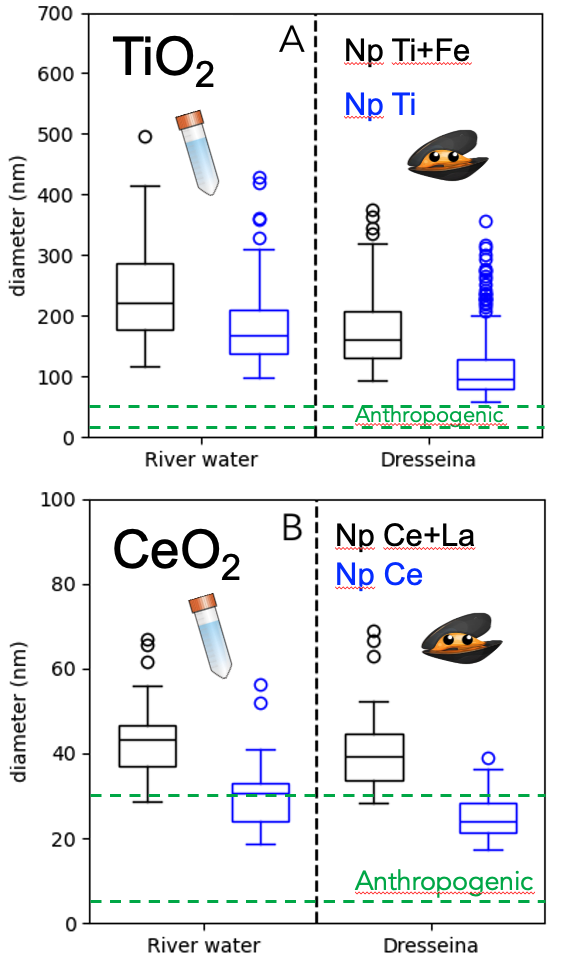
These manufactured particles, ranging from 60 to 500 nm for titanium and 20 to 80 nm for cerium, are substantially larger than their primary manufactured size (5 to 50 nm and 5 to 30 nm respectively), reflecting extensive aggregation once released into water — a process favoured by the Seine’s abundant calcium and low dissolved organic matter content.

Size distribution of particles containing both Ti and Fe (in black) and particles only containing Ti (in blue) in river water (left) and Dreissena (right). B – Size distribution of particles containing both Ce and La (in black) and particles only containing Ce (in blue) in river water (left) and Dreissena (right).

Zebra mussels as valuable biological indicators

Analysis of mussel tissue revealed clear bioaccumulation of both particle types, with a linear relationship between titanium particle concentrations in water and those measured in exposed mussels, confirming their potential as bioindicator organisms. Ti:Fe and Ce:La ratios measured in tissues remained close to those observed in water, suggesting that Dreissena polymorpha can provide qualitative information on the types of particles present in the environment — although rapid depuration limits this use to snapshot monitoring rather than long-term integration.

Towards better consideration of nanoparticles in river monitoring

These findings show that, in a basin as urbanised as the Seine, inputs of manufactured nanomaterials have now reached a level comparable to the natural geochemical background. Nanoparticles account for the bulk of titanium transported by the river (9 to 70% of total titanium, compared with just 0.3 to 0.5% in dissolved form), while regulatory monitoring typically focuses on dissolved metal fractions. This work therefore calls for greater consideration of the nanoparticulate fraction in future environmental monitoring protocols for heavily anthropised rivers.

Reference
Wang, F.; Tharaud, M.; Benedetti, M. F. Occurrence, Sources, and Export Rates of Ti-Bearing and Ce-Bearing (Nano)particles in the Seine River Where Engineered Nanoparticles Reach Natural Background Levels. Environ. Sci. Technol. 2026, https://doi.org/10.1021/acs.est.6c01429.

Funding : IPGP PARI multidisciplinary programme, Paris-Île-de-France region (SESAME Grant no. 12015908), PIREN-Seine subproject C20/1541A01, IdEx Université de Paris (ANR-18-IDEX-0001).

Latest news
Razvan Caracas elected President-elect of the International Mineralogical Association
At the IMA General Meeting held last month in Nanjing, Razvan Caracas, CNRS senior researcher at the Institut de Physique du Globe de Paris, was ele...
Nepal–Tibet: reconstructing the dynamics of a high-mountain hazard cascade
On 26 August 2026, a major rock-and-ice collapse occurred near the border between Nepal and Tibet. As it travelled through a confined valley, the movi...
Sand grains realize a Brownian motor conceived forty years ago
A team led by Olivier Devauchelle, a researcher at the Institut de physique du globe de Paris (IPGP/Université Paris Cité/CNRS), working with colleagu...
Marc Chaussidon has been awarded the 2026 Leonard Medal, the Meteoritical Society’s highest honour
On the occasion of its 88th Annual Meeting the Meteoritical Society has presented the 2026 Leonard medal to Marc Chaussidon for his transformative con...