

Citizen / General public
Researcher
Student / Future student
Company
Public partner
Journalist
Teacher / Pupil

The isotopic composition of oxygen in the solar system finally explained

A multidisciplinary team of French and British researchers—affiliated with the Institut de physique du globe de Paris (Université Paris Cité/IPGP/CNRS), the Institut de minéralogie, de physique des matériaux et de cosmochimie (Muséum national d’histoire naturelle/Sorbonne Université/CNRS), the Laboratoire des sciences des procédés et des matériaux (Université Sorbonne Paris Nord/CNRS), the Centre de recherches pétrographiques et géochimiques (CNRS/Université de Lorraine), and the Department of Earth and Environmental Sciences (University of Manchester)—has published a study in the journal Proceedings of the National Academy of Sciences that sheds new light on one of the major mysteries surrounding the formation of the solar system: the isotopic composition of oxygen.
The isotopic composition of oxygen in the solar system finally explained

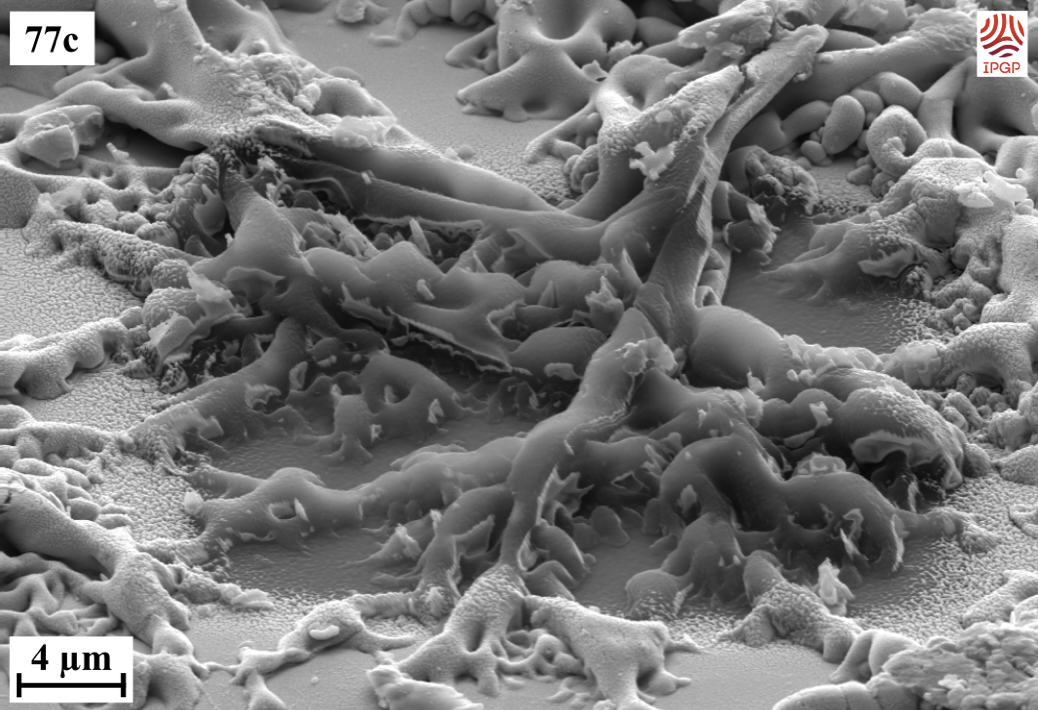
Condensates of organic matter produced during experiment 77c. The darker region shows one of the oxygen isotopic composition analyses / @IPGP

Publication date: 05/05/2025

Events, Press, Research

Why do all solids formed in the solar system have isotopic compositions so different from that of the primordial gas (the protosolar nebula) represented by the sun?
Since the 1970s, scientists have puzzled over the stark differences between the oxygen isotopic composition of terrestrial planets, asteroids, and comets, and that of the sun—determined with high precision through the analysis of solar wind returned to Earth by NASA’s Genesis mission.

In the 1980s, the discovery that ozone formation in Earth’s upper atmosphere generates isotopic variations similar to those observed in meteorites led to the hypothesis that analogous reactions might have occurred in the protosolar nebula. However, no theoretical model or laboratory experiment had been able to confirm this hypothesis.

To resolve this mystery, the researchers experimentally reproduced the condensation of solids within a plasma mimicking the protosolar nebula in terms of chemical composition (methane and water vapor), pressure, and ionization rate. Their results show for the first time that solids condensed at high temperatures in such a plasma exhibit oxygen isotopic variations characteristic of terrestrial planets and small bodies in the solar system. The experiments suggest these variations stem from a reaction involving a short-lived activated complex, H₂O₂*, within the plasma. While this reaction alone cannot account for all observed isotopic variations, other activated complexes such as SiO₂* or CO₂* may also play a key role.

These discoveries pave the way for reconstructing the chain of reactions that led to the formation of the first solids in the solar system—an objective that had remained out of reach until now.

Source
Mass-independent fractionation of oxygen isotopes during high-temperature condensation in cosmochemical plasmas

DOI : https://doi.org/10.1073/pnas.2426711122

Contacts :
IPGP : Pierre-Yves Clausse I I + 33 (0)6 51 67 84 83
CNRS : Bureau de presse I I +33 (0)1 44 96 51 51

Latest news
Millennial seismic supercycles revealed in the Ryukyu subduction zone using fossil corals
An international study led by researchers from the institut de physique du globe de Paris shows that the Ryukyu subduction zone, southwest of Japan, h...
A remarkable magnetic event observed all around the Earth
On the evening of 19/01/2026 a rapid variation of the magnetic field, synchronous on a large part of our planet, has been detected by an automatic sys...
🌋 Piton de la Fournaise: an eruption underway on the northern flank of the volcano
Comprendre les premières heures deUnderstanding the first hours of the eruption on 18 January 2026Thanks to one of the densest networks of monitoring ...
Beneath Antarctica: the deep-time story behind Earth's largest
Beneath Antarctica: the deep-time story behind Earth's largest "gravity low"
Why is gravity slightly weaker above Antarctica than anywhere else on Earth? And how did this remarkable anomaly emerge – and then steadily intensify ...