
Citizen / General public
Researcher
Student / Future student
Company
Public partner
Journalist
Teacher / Pupil

The study of a meteorite provides insights into the early stages of solar system formation

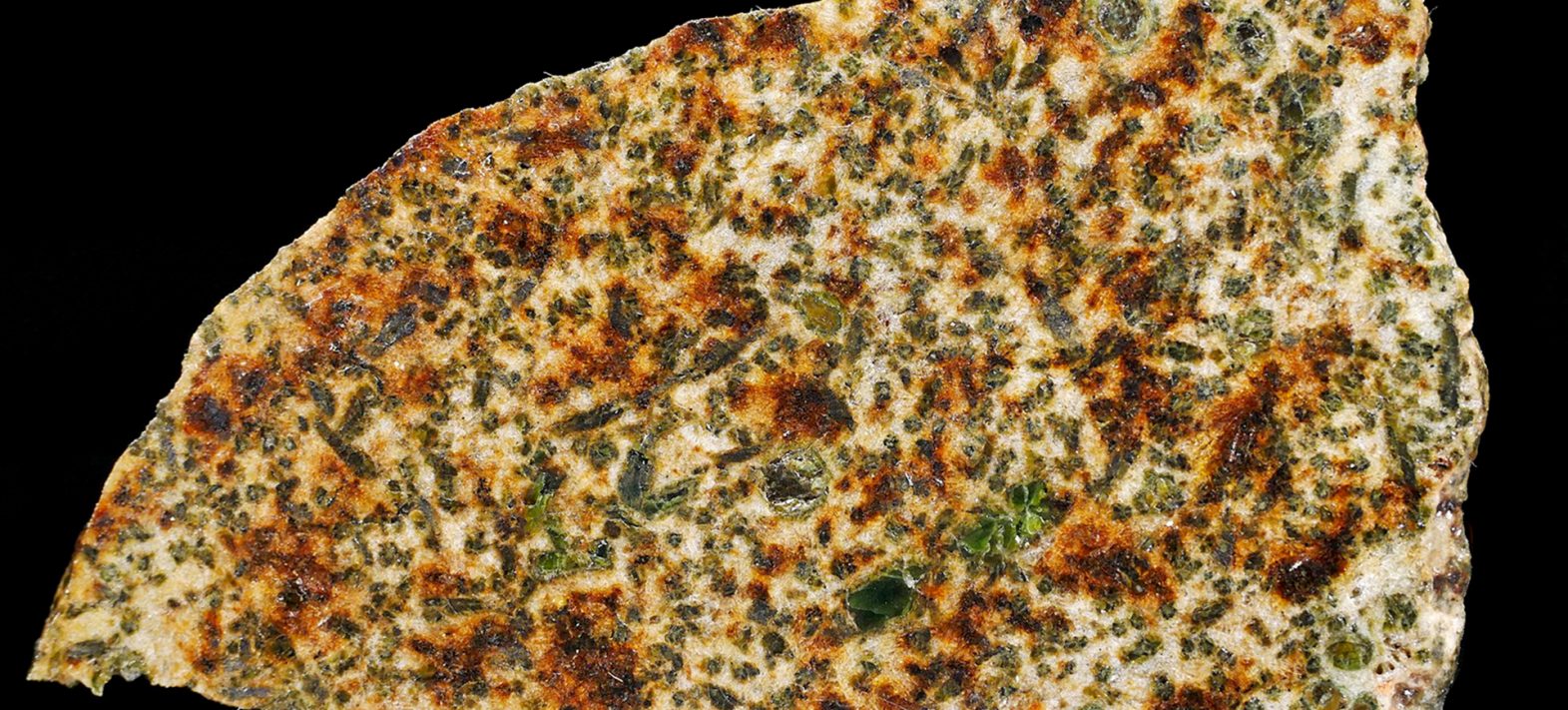
A study led by researchers at the Institut de Physique du Globe de Paris (IPGP), published in the journal Science Advances on January 8, 2025, reveals a breakthrough in our understanding of the early stages in the formation of the solar system. By studying the oldest known differentiated meteorite, Erg Chech 002 (EC 002), they have established a new reference for the initial abundance of the radioactive isotope 60Fe, while revealing the precocity of asteroid metal core formation processes.
The study of a meteorite provides insights into the early stages of solar system formation

sample of meteorite Erg Chech 002

Publication date: 09/01/2025

General public, Press, Research

Related themes : Origins

The isotope 60Fe, with a half-life of 2.62 million years, no longer exists in the solar system. However, its decay product, still present in 60Ni samples, enables us to deduce its initial abundance, a crucial parameter for dating the formation of the metallic cores of planetesimals – the precursor bodies of planets. Until now, estimates of 60Fe’s initial abundance varied considerably, ranging from 10-⁹ to 10-⁶, making its use as a cosmic chronometer uncertain.

In this study, the researchers developed a new method for nickel isotope analysis, combining unrivalled sensitivity and accuracy using MC-ICP-MS mass spectrometry. This approach enabled them to precisely define an initial 60Fe/56Fe ratio of (7.71 ± 0.47) × 10-⁹, a value five times more accurate than previous estimates. This result, now recommended as a standard reference, confirms that the radioactive 60Fe isotope originates from the interstellar medium, ruling out the hypothesis of late injection by supernovas into the early solar system.


Asteroid cores formed very early on

Using 60Fe-60Ni chronologies, the researchers also dated the formation of the metal cores of several asteroids:

  • EC 002: differentiated metal only ~0.82 million years after the formation of the solar system.
  • Asteroid Vesta-4: core formation ~0.95 million years ago.
  • Angrite parent body: formation ~2.27 million years ago.

These results show that the differentiation of asteroids – i.e. their transformation into bodies with a distinct core, mantle and crust – took place extremely early, within the first two million years after the birth of the solar system. Most of the meteorite fragments we possess today therefore come from these rapidly-forming bodies.

Unsuspected thermal and volcanic diversity


The study also reveals the stages in the thermal evolution of EC 002’s parent planet. After the stabilization of a chondritic crust at the top of a magmatic ocean, metallic segregation occurred at moderate temperatures (1000°C to 1200°C), before an intense silicate melting event at 1.62 million years ago. These observations highlight the diversity of volcanic processes and evolutionary trajectories of the first planetesimals.

Réf : Fang, Moynier, Chaussidon, Limare, Majhatadze, Villeneuve, The initial solar system abundance of 60Fe and early core formation of the first asteroids. Science Advances.

Latest news
SOUFRIÈRE_50: a week to revisit fifty years of scientific progress and meet the challenges of 21st-century volcanology
Press Release - Fifty years after the 1976–1977 eruption of La Soufrière de Guadeloupe—an event that left a profound mark on Guadeloupe, as well as on...
QVCT Week is back at the IPGP from 15 to 19 June 2026!
For the second year running, Quality of Life and Working Conditions Week (QVCT) is back at the IPGP. It’s an opportunity to strengthen bonds between c...
Jean-Philippe Avouac featured at the U.S. National Academy of Sciences annual meeting
Jean-Philippe Avouac, Director of the Institut de physique du globe de Paris (IPGP) and Professor at the California Institute of Technology (Caltech),...
Non-biological organic carbon recycled in Earth’s depths
A study published in Nature Communications, involving teams from the Institut de physique du globe de Paris, reveals a major and previously underestim...