
Citizen / General public
Researcher
Student / Future student
Company
Public partner
Journalist
Teacher / Pupil

Wildfires: nanoparticles reveal combustion conditions

A study conducted by researchers at the Institut de physique du globe de Paris (IPGP) and Université Paris Cité, in collaboration with Memorial University of Newfoundland and ENSMA in Poitiers, shows that the composition and magnetic properties of nanoparticles produced during biomass combustion vary systematically with fire intensity. These results, published in an international peer-reviewed journal, pave the way for new markers to assess fire conditions after the event, without the need to have been present during it.
Wildfires: nanoparticles reveal combustion conditions

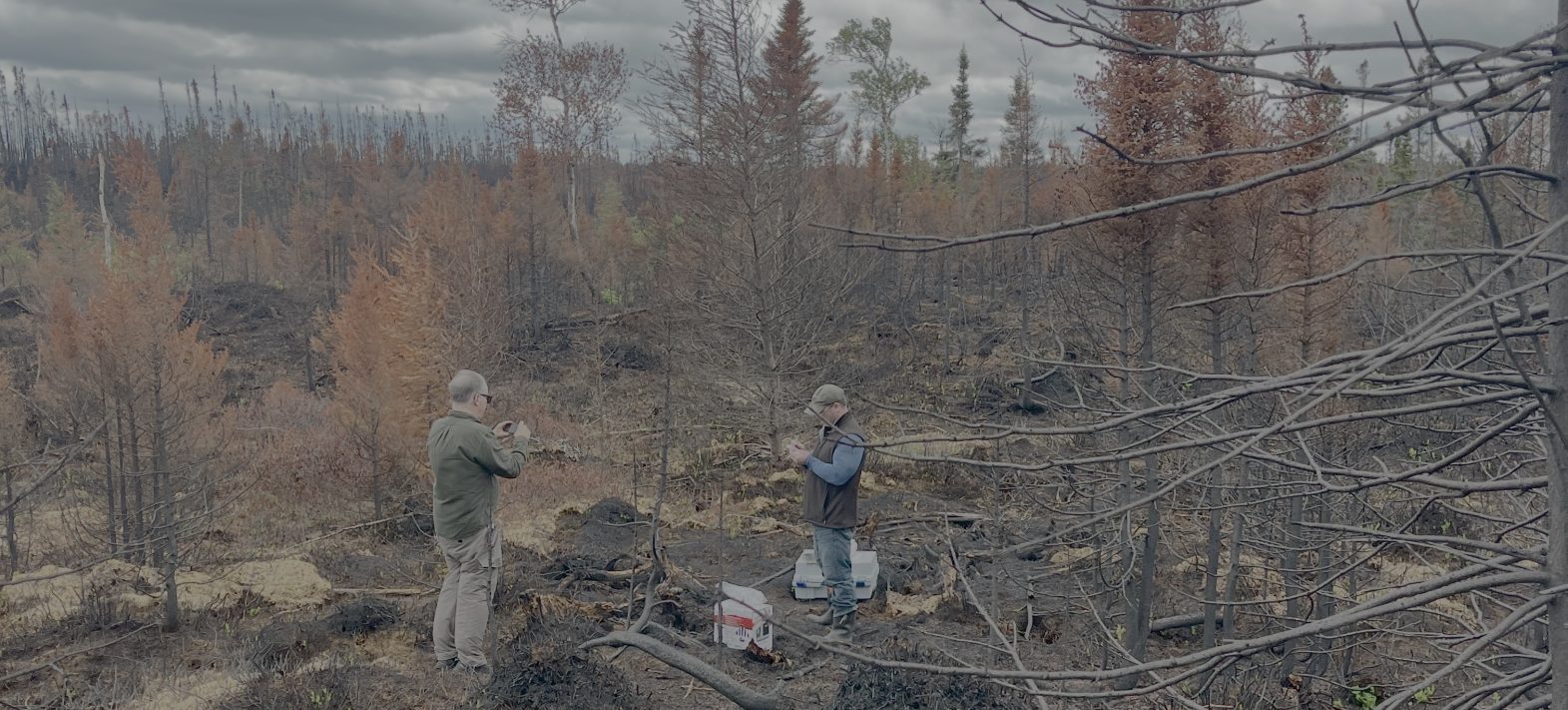
Sampling of charred soil and vegetation in Badger, Canada, by teams from IPGP and Memorial University of Newfoundland / @Sélène CALVEL

Publication date: 29/06/2026

Research
A major challenge: understanding fires to better protect the environment
Wildfires are increasing worldwide, exacerbated by climate change. A report by the United Nations Environment Programme (UNEP) anticipates a 30% rise in extreme fires by 2050. Beyond visible damage, these fires profoundly transform soils and release potentially toxic metallic elements, particularly in the form of nanoparticles. These particles, smaller than 100 nm, have a large reactive surface area and can disperse through the atmosphere, soils, and waterways, carrying heavy metals or organic contaminants with them.
Despite their importance, the nature and concentration of these incidental nanoparticles in ash and charred wood had been very little studied.

Controlled experiments and State-of-the-Art analyses
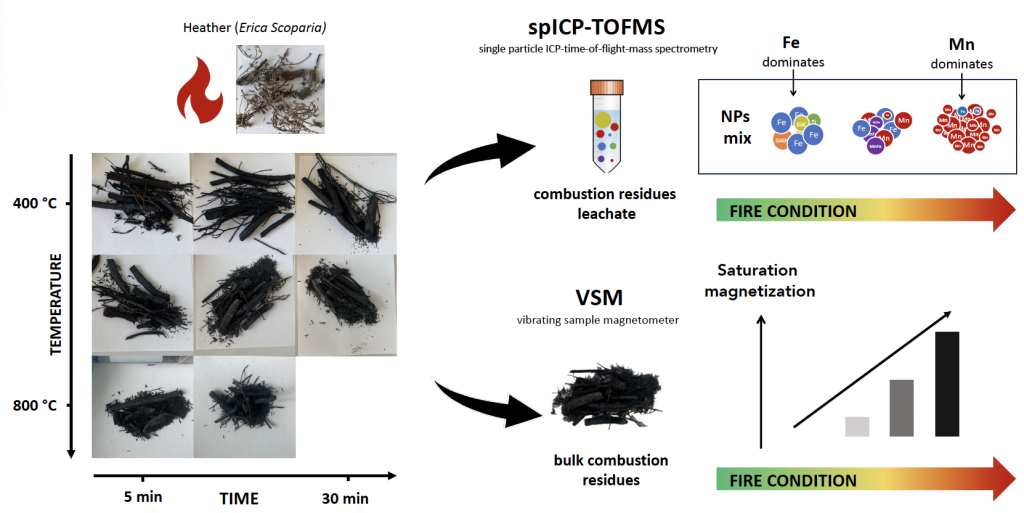
The team burned laboratory samples of heather (Erica scoparia), the dominant species of Mediterranean heathlands, at three different temperatures (400, 550, and 800 °C) and for varying durations (5, 15, and 30 minutes), thereby reproducing the main fire regimes, from smouldering fires to intense crown fires. The combustion residues were then analysed using two original and complementary methods:
Single-particle inductively coupled plasma time-of-flight mass spectrometry (spICP-TOFMS), hosted on the PARI platform at IPGP, which enables characterisation of the elemental composition of each nanoparticle present in combustion residue leachates.
Magnetic measurements (susceptibility and saturation magnetisation), which provide information on the nature and concentration of iron oxides formed during combustion.

From iron to manganese: a transformation driven by temperature
The results reveal a radical shift in nanoparticle composition depending on combustion conditions. Fresh and low-temperature (<400 °C) burned samples release particles predominantly rich in iron (more than 50%). In contrast, high-temperature combustion (800 °C) releases manganese nanoparticles (more than 95%). Between these two extremes, at 550 °C, an original population of bimetallic iron–manganese (FeMn) nanoparticles appears, reflecting complex redox interactions between these two elements.
Furthermore, magnetic measurements show that combustion intensity promotes the transformation of initial iron oxides into highly magnetic phases, such as magnetite, through the reducing action of gases released from the combustion of organic plant matter. Saturation magnetisation (Ms), normalised to the initial mass, increases systematically with temperature and combustion duration.

Post-fire markers for environmental assessment
These findings have also significant practical implications: they establish several proxies for fire conditions, usable after the fire without the need to have been present during the event. The enrichment of manganese nanoparticles in burned soil leachates, the high magnetic signature of residues, and the appearance of bimetallic FeMn particles are all complementary indicators of combustion intensity.
These tools could significantly improve post-fire environmental risk assessments, particularly regarding the mobility of heavy metals towards surface waters and aquatic ecosystems. Further studies on other plant species and soil types will enable these results to be generalised to different ecological contexts.

Publication reference
Calvel S.; Isambert A.; Tharaud M.; Chad C.; Carlut J.; Coudour B. and Benedetti M.F. Temperature-Dependent Particle Formation during Biomass Combustion: A Combined spICP-TOFMS and Magnetic Study. Environ. Sci. Nano 2026, 10.1039. https://doi.org/10.1039/D6EN00319B

Funding: Post-FIRE Project (ANR-23-CE34-0010), IPGP PARI programme, SESAME Île-de-France, IdEx Université de Paris (ANR-18-IDEX-0001), France 2030 (ANR-21-EXES-0002).

Latest news
Radio ‘whistlers’ originating from lightning strikes reveal unprecedented behaviour above the magnetic equator
A team from the Institut de Physique du Globe de Paris (IPGP – Université Paris Cité / CNRS) has, for the first time, documented and explained the unu...
What can the light from Vesta’s avalanches tell us?
A study conducted at the Institut de Physique du Globe de Paris uses images from NASA’s Dawn mission and a Bayesian inversion of the Hapke photometric...
Cosmochemistry in the service of Alzheimer's disease diagnosis: copper reveals its isotopic secrets
A multidisciplinary study led by researchers at the Institut de Physique du Globe de Paris (IPGP), in collaboration with teams from the Faculty of Hea...
Are the hidden currents of Ganymede’s ocean finally detectable?
A study conducted by researchers from the Institut de physique du globe de Paris (IPGP) and CNRS shows that the convection motions driving the hidden ...