
Citizen / General public
Researcher
Student / Future student
Company
Public partner
Journalist
Teacher / Pupil

A study led by scientists from the Institut de physique du globe de Paris, in collaboration with the École Polytechnique Fédérale de Lausanne, reveals the presence of material formed during the very earliest stages of Earth’s history in lavas from the submarine volcano Fani Maoré, near Mayotte.
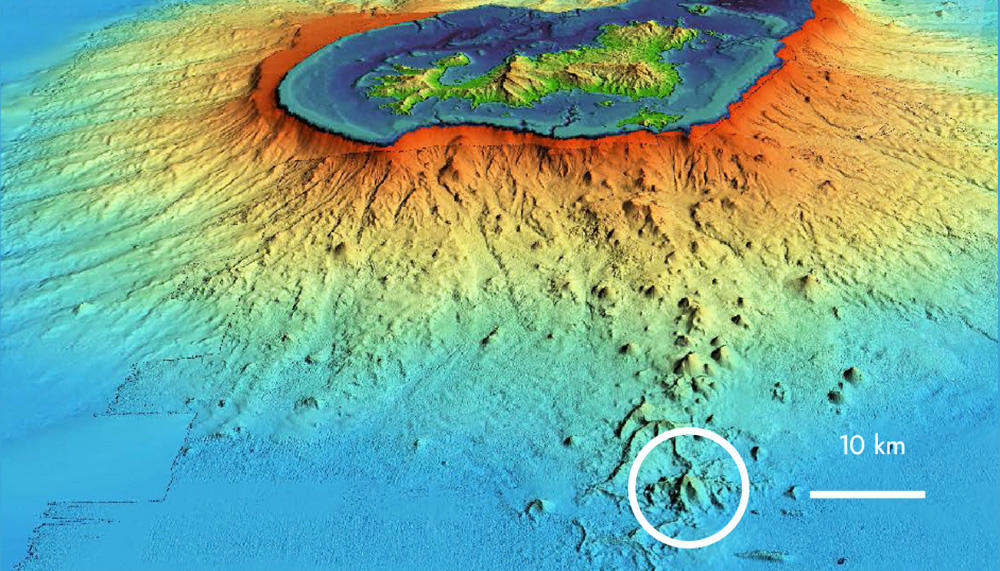
In May 2019, data from the Mayobs scientific campaign revealed that the volcano, located 50 kilometers from the island, stood just over 800 meters tall and showed intense activity at a depth of 3,500 meters. It is shown here circled.

Publication date: 10/07/2026

Research

Born during the seismo-volcanic crisis that affected Mayotte between 2018 and 2021, the submarine volcano Fani Maoré continues to provide valuable insights into the deep interior of our planet. In a new study, researchers from the IPGP and EPFL show that some of its lavas carry the signature of extremely ancient material, formed around 4.4 billion years ago, at the very beginning of Earth’s history.
This discovery is based on ultra-high-precision measurements of neodymium isotopes, a chemical element used as a tracer of mantle evolution. The scientists identified a slight excess of the isotope ¹⁴²Nd in the lavas from Fani Maoré. This extremely subtle signal indicates that the source of these magmas contains a component formed within the first 100 million years of Earth’s history, at a time when our planet was still largely dominated by a vast magma ocean.
A trace of the primordial magma ocean
After its formation, and particularly after the giant impact thought to have given rise to the Moon, Earth likely experienced a period during which much of its mantle was molten. As this magma ocean cooled, it progressively crystallised, forming, among other minerals, bridgmanite — the most abundant mineral in Earth’s deep mantle.
The results of the study suggest that this very ancient, or Hadean, bridgmanite preserved a distinctive chemical signature linked to its depletion in light rare earth elements. A fraction of this material may then have survived for nearly 4.4 billion years within the mantle, despite plate tectonics and mantle convection, before being remobilised in the source of present-day volcanism at Fani Maoré.
A less homogeneous mantle than previously thought
This discovery sheds new light on the internal dynamics of the Earth. The mantle is often described as a constantly moving system, stirred over immense geological timescales. Yet the presence of such a signature in recent lavas shows that some very ancient chemical heterogeneities may have been preserved to the present day.
According to the models proposed in the study, a small proportion of this Hadean material — around ten percent of the mantle source of Fani Maoré — could be enough to explain the observed isotopic anomaly. This hypothesis opens up the possibility that relics of Earth’s primordial magma ocean may be more widespread in the present-day mantle than previously assumed.
Beyond the case of Mayotte, this work invites us to reconsider how the earliest stages of Earth’s differentiation left traces in the deep mantle. It also shows how present-day volcanoes can still carry the memory of our planet’s very first moments.

Reference: Hadean bridgmanite in the source of a present-day ocean island, by Claudine Israel, Catherine Chauvel, Edward Inglis, Hui Chen, Cécile Hébert and James Badro.

Latest news
SOUFRIÈRE_50 – 50 years of scientific advances on volcanoes for a more resilient future
Few days before the opening of the international conference SOUFRIÈRE_50 – 50 years of scientific advances on volcanoes for a more resilient future, t...
Wildfires: nanoparticles reveal combustion conditions
A study conducted by researchers at the Institut de physique du globe de Paris (IPGP) and Université Paris Cité, in collaboration with Memorial Univer...
Radio ‘whistlers’ originating from lightning strikes reveal unprecedented behaviour above the magnetic equator
A team from the Institut de Physique du Globe de Paris (IPGP – Université Paris Cité / CNRS) has, for the first time, documented and explained the unu...
What can the light from Vesta’s avalanches tell us?
A study conducted at the Institut de Physique du Globe de Paris uses images from NASA’s Dawn mission and a Bayesian inversion of the Hapke photometric...