
Citizen / General public
Researcher
Student / Future student
Company
Public partner
Journalist
Teacher / Pupil

Active weather and organic chemistry on Titan: new observations from the James Webb space telescope

The James Webb space telescope (JWST), in collaboration with the ground-based Keck II telescope, has for the first time observed cloud convection in the northern hemisphere of Titan, Saturn’s largest moon. This study, which includes contributions from researchers at the IPGP, offers new insights into the atmospheric dynamics and organic chemistry of this astrobiologically significant body. Conducted as part of JWST’s guaranteed time observations program, the research has been published in Nature Astronomy
Active weather and organic chemistry on Titan: new observations from the James Webb space telescope

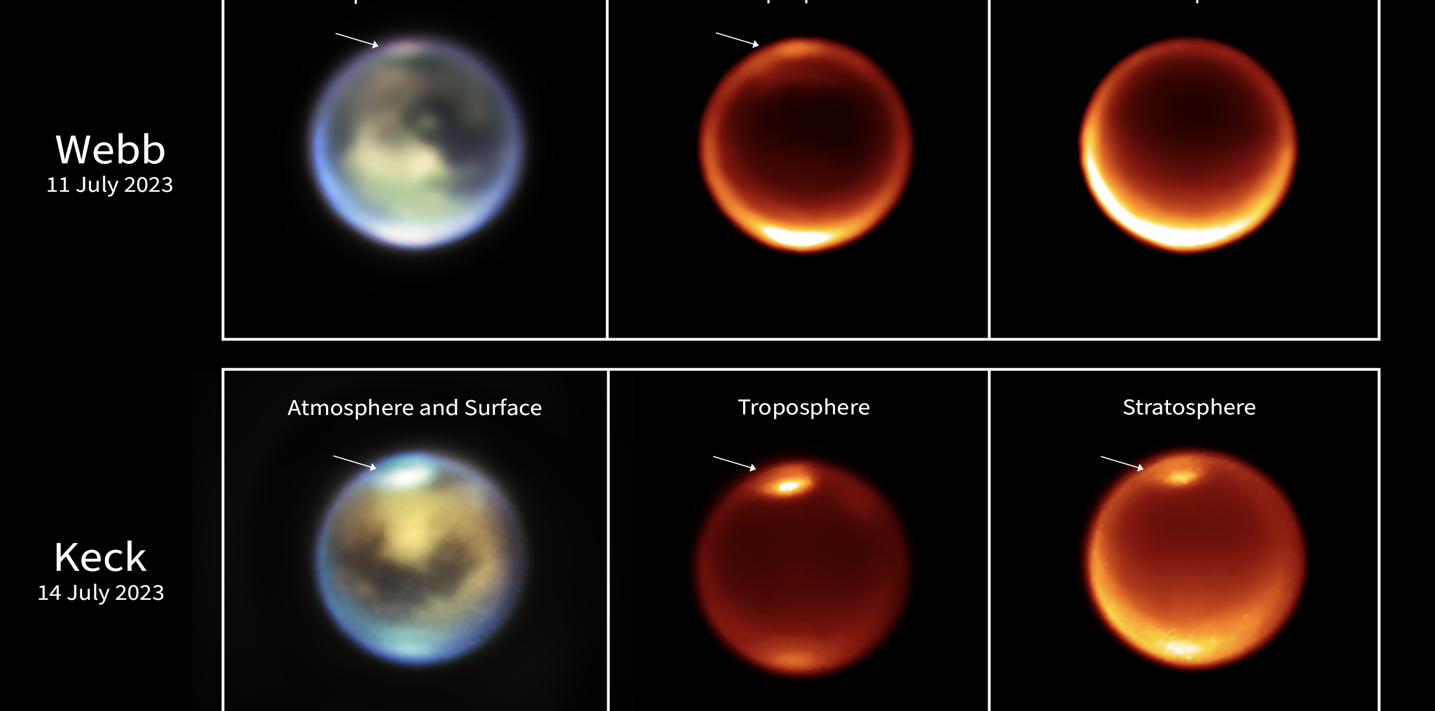
Images de Titan captées en juillet 2023 par le télescope spatial James Webb (11/07) et Keck (14/07), révélant des nuages de méthane à différentes altitudes / @NASA/STScI/WMKO/Alyssa Pagan
Publication date: 16/06/2025

Press, Research

Unprecedented data to visualize Titan’s atmosphere
Data collected in November 2022 and July 2023 by JWST and the W. M. Keck observatories reveal methane clouds forming at various altitudes in Titan’s northern hemisphere. Thanks to specific infrared filters (ranging from 1.4 to 2.17 microns), researchers were able to probe multiple atmospheric layers — from the lower troposphere to the stratosphere — and observe vertical cloud motion, indicating strong convective activity.
The images notably show the upward movement of cloud formations between 11 and 14 July 2023, confirming for the first time a convection phenomenon at high northern latitudes. This type of observation marks a major step forward in understanding Titan’s methane cycle and its complex meteorology.

Methane-driven weather on Titan
On Titan, methane plays a role similar to that of water on Earth: it evaporates from lakes and seas, condenses in the atmosphere, forms clouds, and occasionally rains down on the icy surface.
The observations show clouds in Titan’s northern hemisphere — a region home to most of its methane lakes, which are comparable in size to North America’s Great Lakes. This corresponds to the summer season in that hemisphere. The ascent of clouds to altitudes reaching 45 kilometers (compared to just 12 on Earth) illustrates the vertical dynamics of Titan’s extended atmosphere, made possible by the moon’s low gravity.

A breakthrough in cryogenic organic chemistry

Alongside these meteorological observations, the study marks a significant breakthrough in the study of Titan’s organic chemistry: the detection of the methyl radical (CH₃), an unstable compound formed during methane dissociation. Previously undetected in Titan’s atmosphere, this molecule is a key intermediate in the chain of reactions that produce complex hydrocarbons.
Its presence highlights Titan’s chemical richness. The atmospheric processes observed could shed light on the conditions that favor the emergence of life. The ability to track these reactions in progress, rather than solely through their end products, represents a crucial advance in understanding organic environments beyond Earth.

A fragile atmospheric cycle

The study also points to the fragility of Titan’s methane cycle. Some of the methane is transformed into heavier compounds that fall back to the surface, while some is lost when hydrogen escapes into space. Without deep reservoirs to replenish atmospheric methane, Titan’s atmosphere could gradually become depleted — a phenomenon similar to the water loss Mars experienced in its past.

Looking ahead to the Dragonfly mission

These findings continue the scientific momentum from the Cassini-Huygens mission (1997–2017) to NASA’s upcoming Dragonfly mission, set for 2034. This octocopter drone will conduct multiple flights across Titan’s surface to explore different sites and analyze their composition.
Combined with data from major observatories (JWST, Hubble, Keck), Dragonfly will significantly deepen our understanding of Titan and help illuminate the physicochemical conditions that may exist on other celestial bodies.


Latest news
SOUFRIÈRE_50: a week to revisit fifty years of scientific progress and meet the challenges of 21st-century volcanology
Press Release - Fifty years after the 1976–1977 eruption of La Soufrière de Guadeloupe—an event that left a profound mark on Guadeloupe, as well as on...
QVCT Week is back at the IPGP from 15 to 19 June 2026!
For the second year running, Quality of Life and Working Conditions Week (QVCT) is back at the IPGP. It’s an opportunity to strengthen bonds between c...
Jean-Philippe Avouac featured at the U.S. National Academy of Sciences annual meeting
Jean-Philippe Avouac, Director of the Institut de physique du globe de Paris (IPGP) and Professor at the California Institute of Technology (Caltech),...
Non-biological organic carbon recycled in Earth’s depths
A study published in Nature Communications, involving teams from the Institut de physique du globe de Paris, reveals a major and previously underestim...