
Citizen / General public
Researcher
Student / Future student
Company
Public partner
Journalist
Teacher / Pupil

The exceptional magnetic storm observed by the IPGP

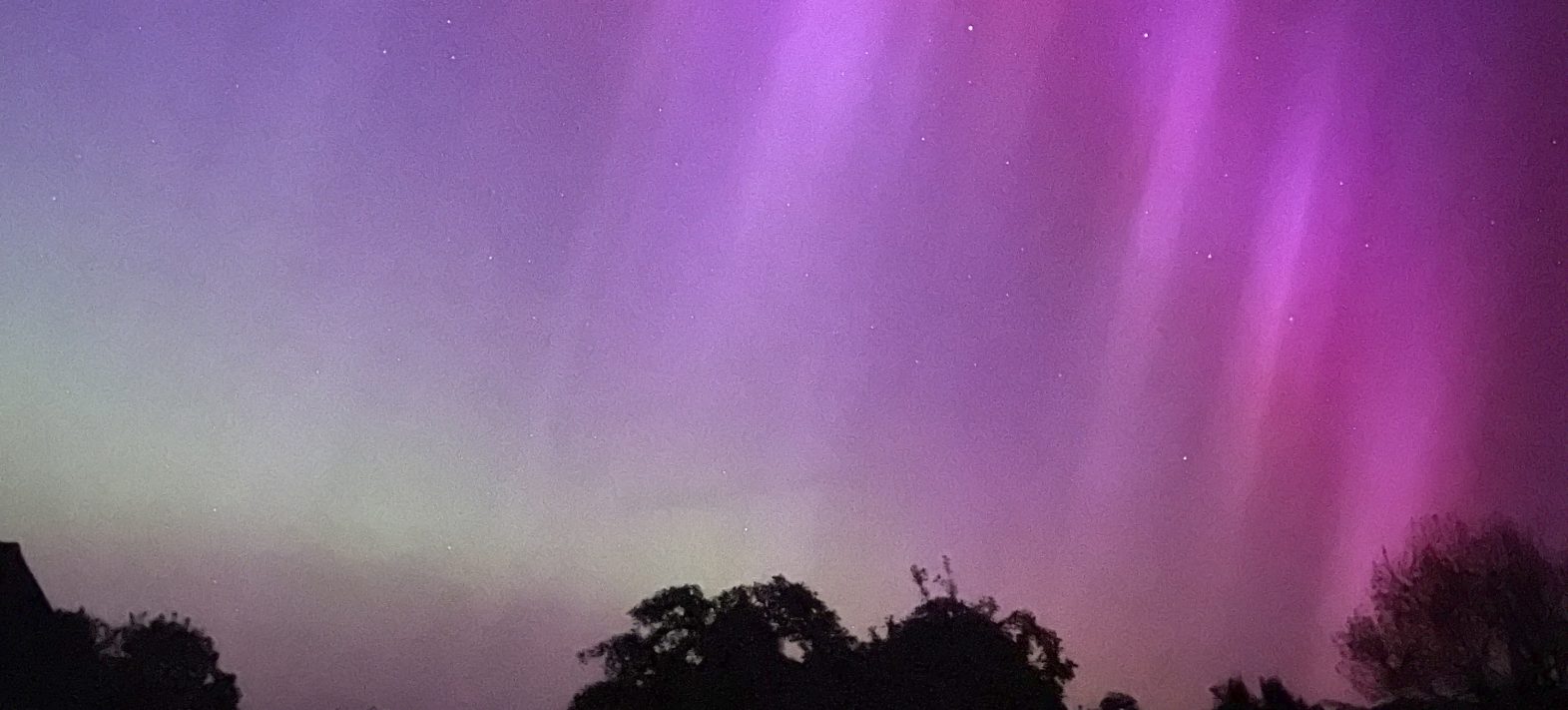
On 10 and 11 May, a large part of the northern hemisphere was able to observe the aurora borealis at exceptionally low latitudes. These luminous phenomena are the most visible manifestations of intense solar activity over the preceding days, which interacted with the Earth's magnetic field to produce an exceptional magnetic storm. The Magnetic Observatories Department of the IPGP, which recorded the storm at stations in its network, takes a closer look at this extraordinary event.
The exceptional magnetic storm observed by the IPGP

Publication date: 17/05/2024

Observatories, Press

Related observatories : Magnetic observatories

On 10 May 2024, the Earth’s magnetosphere, which protects us from particles arriving from the cosmos, was hit by clouds of very fast particles from the Sun. The Sun is currently at its most active. Eruptions are occurring on its surface, in regions that appear as dark spots, known as sunspots. The eruptions that occurred between 8 and 10 May 2024 were particularly strong, originating from an extremely extensive sunspot system.

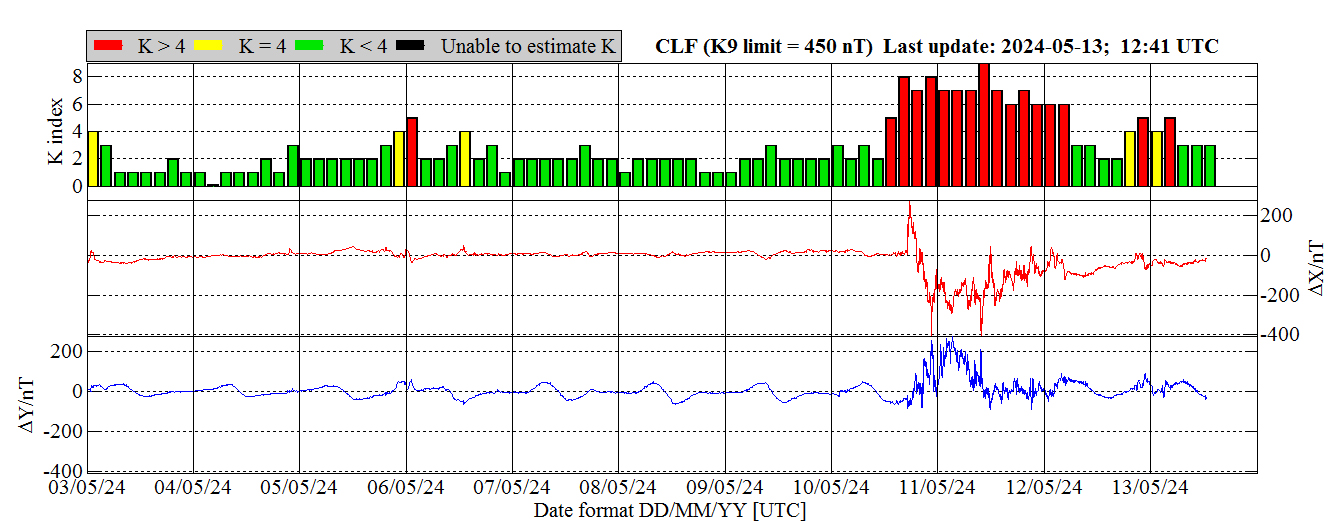
This event triggered the strongest magnetic storm for more than twenty years, and the magnetometers in the network maintained by the IPGP recorded the whole of this rare event. Most of the observatories in our network reached the maximum level of magnetic activity, measured by the K index, over the following two days.

Recording magnetic activity at the Chambon-la-Forêt station

This exceptional magnetic storm had its visible manifestation in spectacular polar auroras, which were visible on the following nights over virtually the whole of mainland France. Such an event can also cause disruption, particularly to electricity grids and radio telecommunications.

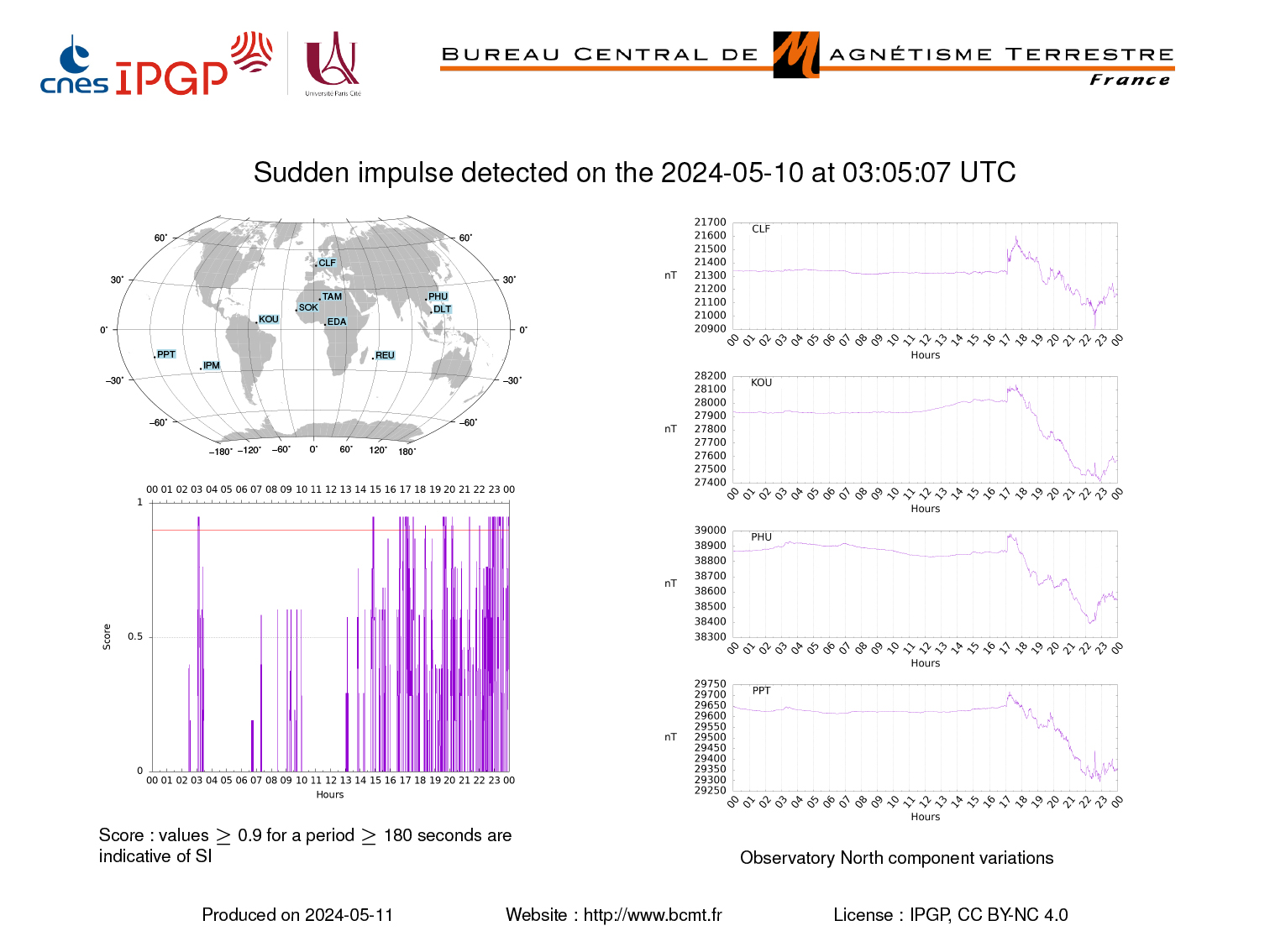
The IPGP’s magnetic observatories department has recently commissioned a new system for automatically detecting the magnetic signal associated with the onset of a solar storm. This system sends a message to the interested scientific and industrial communities, indicating the impact on the magnetosphere when the solar eruption arrives.


> Read more: https://www.ipgp.fr/en/observation/observatoires-magnetiques

Automatic signal detection of magnetic activity associated with the start of a thunderstorm
Latest news
Komatiites reveal that Earth's surface water reached the deep mantle over 3.6 billion years ago
A new study led by Dr. Zheng-Yu Long and Prof. Frédéric Moynier, researchers at the Institut de Physique du Globe de Paris (IPGP/Université Paris Cité...
Satellites reveal irreversible damage in a major California aquifer
A study published in Proceedings of the National Academy of Sciences (PNAS), to which Kristel Chanard, Manon Dalaison and Jean-Philippe Avouac of the ...
Academic research: a key lever for addressing the water challenge in Africa... and elsewhere!
A new Nature Sustainability publication to which Essam Heggy (lecturer-researcher at IPGP) contributed, reveals how stronger support for African-focus...
A new isotopic clue reveals the origin of the asteroid responsible for the extinction of the dinosaurs
A study led by Georgy V. Makhatadze, a postdoctoral researcher at the Institut de physique du globe de Paris (Université Paris Cité / CNRS) under the ...