Afin d'être accessible au plus grand nombre, nous vous informons que vous avez la possibilité de modifier la taille d’affichage du contenu de notre site.
Pour cela, voici les commandes à reproduire à l'aide de votre clavier :
Zoom in
CTRL +
+
Zoom out
CTRL +
-
Reset to zero
CTRL +
0
What can the light from Vesta’s avalanches tell us?
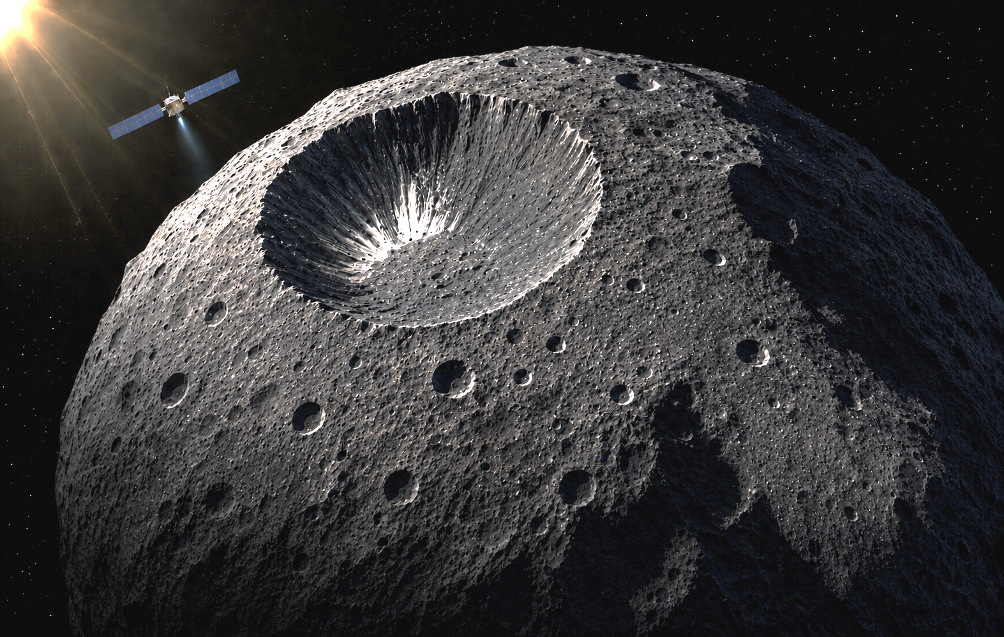
A study conducted at the Institut de Physique du Globe de Paris uses images from NASA’s Dawn mission and a Bayesian inversion of the Hapke photometric model to analyse avalanches and ejecta deposits on the asteroid Vesta. The results show that the brightest deposits correspond to the most recently mobilised surfaces, offering a new way to track the evolution of regolith on airless bodies.
Using images acquired by NASA’s Dawn mission, the researchers focused on two regions of Vesta: bright avalanche deposits in Cornelia crater, and a fresh ejecta deposit located along the Matronalia Rupes scarp. These terrains display strong brightness contrasts, already visible in the images. Their interpretation, however, is not straightforward: a surface may appear bright because it has recently been excavated, because it contains a larger fraction of fine particles, because it is rougher, or because it has been exposed to the space environment for a shorter period of time.
To disentangle these effects, the team used the Hapke photometric model, which relates the light reflected by a surface to the illumination and viewing geometry. This model makes it possible to estimate several effective properties of the regolith, such as its scattering power, photometric roughness, and the way in which grains scatter light. The originality of the study lies in embedding this model within a Bayesian framework, so as to obtain not a single value for each parameter, but probability distributions and therefore an explicit estimate of the associated uncertainties.
The results show that the brightest deposits are also the youngest in a geomorphological sense. In Cornelia crater, the avalanche deposits have a higher single-scattering albedo than both the crater floor and the opposite wall. At Matronalia Rupes, the fresh ejecta deposit is brighter than the associated small crater and than the scarp slope. This hierarchy remains stable even when the researchers test different assumptions about the opposition effect, a phenomenon that can enhance the observed brightness when a surface is viewed from nearly the same direction as the incoming sunlight.
These contrasts suggest that the bright deposits mainly result from recent mechanical processes: avalanching, impact excavation, and grain-size segregation during emplacement. The brightest materials may correspond to fresher, less altered regolith, or to a redistribution of fine and coarse particles during flow. Conversely, darker terrains reflect a more evolved surface, affected by space weathering, mixing with older materials, or a relative depletion in fine particles.
The study therefore shows that photometry can complement classical morphological analysis. Images reveal where avalanches, ejecta deposits, and slopes are located; the light they reflect adds information about their surface state and relative degree of evolution. Even when some properties remain difficult to constrain in absolute terms, the approach provides a robust ranking of deposit “freshness”. This framework could be applied to other airless bodies, where surfaces record the combined history of impacts, mass movements, and space weathering.
Reference D. T. Nguyen, A. Roque-Bernard, A. Lucas, S. Jacquemoud & C. Ferrari, “Bayesian inversion of the Hapke model on (4) Vesta’s avalanches and ejecta: photometric constraints on regolith evolution”, Astronomy & Astrophysics, à paraître. DOI : 10.1051/0004-6361/202557890
Contact presse Antoine Lucas – Planetology and Space Sciences Team : Communication IPGP:
Planetary Research: a new open-access journal for planetary sciences
Led by an international community of researchers, with strong involvement from IPGP scientists, the new journal Planetary Research offers an alternati...
What if the next stars of recycling were… bacteria?
A new comic book from IPGP takes us behind the scenes of metal bio-recovery. Featuring bacteria, precious metals and a generous dose of humour, it rev...
Mapping regolith migration on Phobos to support the MMX sample-return mission
Researchers from the Institut de Physique du Globe de Paris (IPGP), in collaboration with the Centro de Astrobiología (Spain) have published a new stu...
Lorraine Delaroque and Ines Ouar, two IPGP PhD students, receive awards at international conferences
Two doctoral students from the Planetology and Space Sciences team were recently recognized for their research at two international conferences.